Presentation Design
Pitch Deck vs Sales Deck vs Corporate Deck: Which One Do You Need?

A client once told us, “We’ve pitched, presented, and followed up, but nothing is moving.”
When we looked at their slides, the problem became clear. They were using the same deck for investors, customers, and internal reviews. It spoke about vision when customers wanted clarity. It showed product details when investors wanted scale. The deck wasn’t bad; it was just being used in the wrong conversations.
What people don’t realise is that this confusion happens more often in businesses. Pitch decks, sales decks, and corporate decks may look alike, but they serve very different purposes. Using the wrong one can delay decisions or stop them altogether.
In this blog, we explain the differences between the three and guide you in selecting the right deck presentation for the conversation you are about to have.

What Is a Pitch Deck?
Whenever you share a new idea with investors or partners, the first few minutes matter the most. A pitch deck helps you explain what you’re building and why it matters. It lets you skip the details of how everything works.
A pitch deck isn’t designed to finalize a deal immediately. Its main purpose is to spark enough interest to encourage further discussion. This could lead to a follow-up meeting, a more detailed conversation, or the beginning of a funding discussion. This is why pitch decks are common in fundraising rounds, accelerators, and early partnerships.
Investors usually look at a lot of decks in a very short amount of time. So a good one doesn’t try to explain everything, it gives the big picture. What problem you’re solving, how you’re solving it, how big the opportunity is, and who’s behind it.
And since most decks get skimmed before they ever get read carefully, the visuals and overall structure matter a lot. If those don’t land, the conversation often stops right there.
What Is a Sales Deck?
Think about what happens after someone says, “This looks interesting.” The tone changes right away. They are not trying to figure out who you are anymore. They are trying to decide if this actually fits their situation.
That is when a sales deck becomes useful. It is the tool you use to walk them through their own problems and show, step by step, how what you are offering helps. Not in theory. In real terms.
You are not talking about some big future vision at this point. You are in a call, a demo, or a meeting where people are comparing options. So you get specific. You talk about the issues they are dealing with, show examples of how others solved them, explain pricing clearly, and end the conversation by explaining what happens next.

What Is a Corporate Deck?
A lot of companies tell us the same thing. Once they have more teams, investors, and partners, everyone starts hearing a slightly different version of the company. It becomes hard to explain who they are and where things are going without repeating themselves.
That is usually when the idea of a corporate deck comes up. Not to sell anything, but to have one clear story they can use everywhere. Something that works in board meetings, leadership reviews, investor updates, and partner conversations.
When companies talk about what they want in that deck, it is mostly the basics. An overview of the business, what is working, what is not, the priorities right now, what they have already achieved, and what they are planning next. Nothing flashy, just clear.
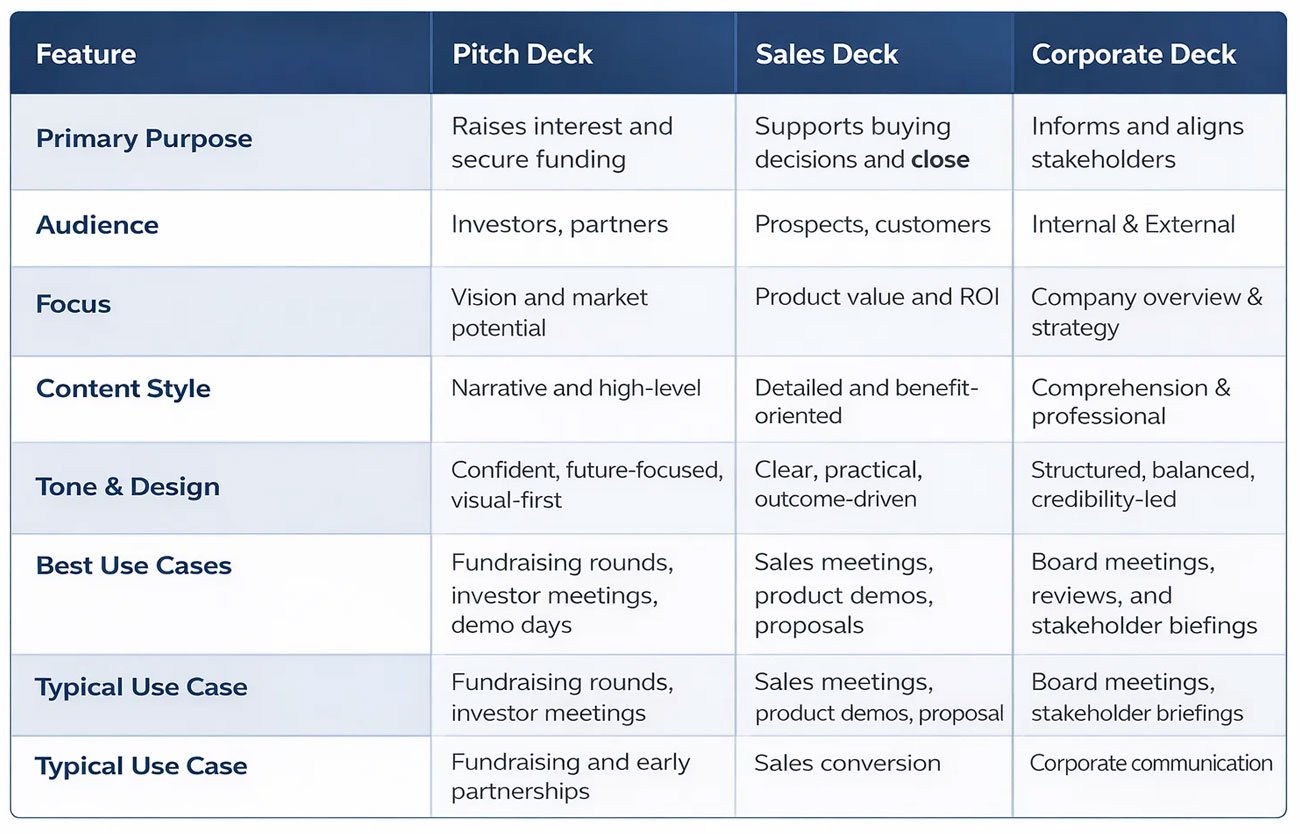
Key Differences: Pitch Deck vs Sales Deck vs Corporate Deck
These three decks may seem alike at first glance, but they are designed for very different business situations. Choosing the wrong one often causes confusion, delays in decision-making, or missed opportunities.
Quick Rule to Remember
- Pitch Deck: Opens doors and starts investor conversation.
- Sales Deck: Closes deals by supporting buying decisions.
- Corporate Deck: Builds trust and alignment across stakeholders.
The Business Impact of Using the Right Deck
We see this all the time. When the right deck is used, conversations move faster. The message lands the way it is supposed to, and people know how to respond. Sometimes that means continuing an investment discussion, sometimes it means moving toward a purchase, and sometimes it is just agreeing on what happens next. Either way, things feel clearer and smoother.
When the wrong deck shows up, everything slows down. Customers get shown investor slides and feel lost. Stakeholders sit through sales decks that never explain the bigger picture. Investors see corporate decks that feel flat and undecided. The business is not the problem. The message is. And because of that, good opportunities often stall or disappear.
Design Tips for Each Deck
-
Pitch Deck
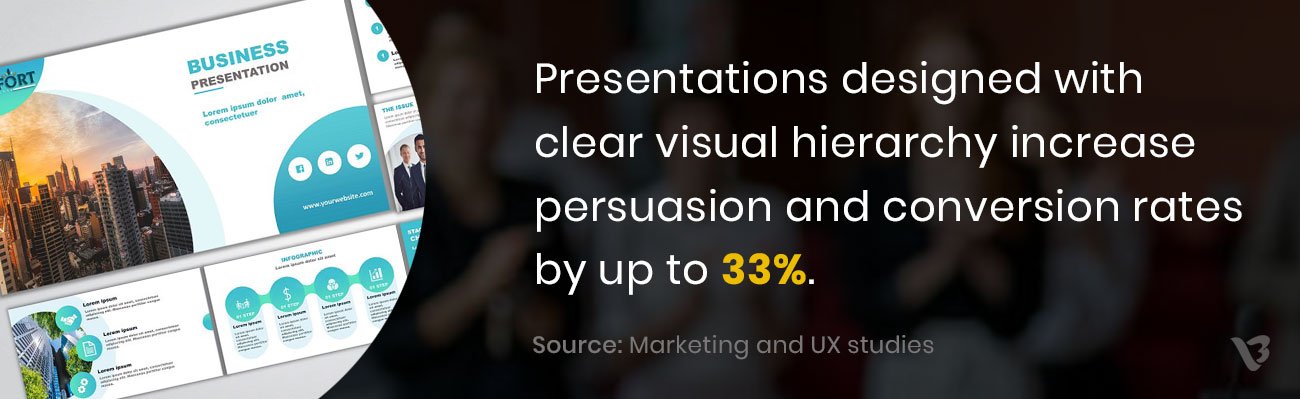
Pitch decks are often reviewed quickly and sometimes without narration. Design needs to help the viewer understand the opportunity in seconds.
Best practices include:
- One clear message per slide
- Minimal text with strong visual hierarchy
- Bold visuals to highlight opportunity, traction, or differentiation
- Brand alignment that supports credibility, not decoration
- Enough white space to make scanning easy
The goal is to guide attention and communicate potential, not explain operations.
-
Sales Deck
Sales decks support evaluation and decision-making and are usually presented live. Design should follow the customer’s thought process.
Best practices include:
- Clear problem-to-solution flow.
- Visuals that show outcomes, not just features.
- Simple data visualisation to support claims.
- Use cases or comparisons to reduce doubt.
- Clear next steps or calls to action.
Good sales deck design reduces friction and helps buyers reach clarity faster.

-
Corporate Deck
Corporate decks are often used both during and after meetings as reference documents. Design must prioritise structure and readability.
Best practices include:
- Clean layouts with consistent grids
- Balanced use of visuals and text
- Clear charts for performance and trends
- Concise storytelling supported by data.
- Consistent typography and restrained colour use.
The focus here is trust, clarity, and professionalism.
Real-World Brand Examples
-
Pitch Deck – Airbnb (Investor Fundraising)
Brand Example: Airbnb
When Airbnb was raising early funding, its pitch deck focused on a single, powerful narrative:
“People are willing to stay in strangers’ homes.”
Instead of explaining every product feature, the pitch deck clearly showed:
- The problem with hotels.
- The market size.
- The business model.
- Early traction and growth potential.
Business Outcome:
- Investors quickly understood the opportunity
- The deck helped Airbnb raise early capital and scale globally
Why this worked:
Airbnb used a Pitch Deck to sell vision and potential, not operational details.
-
Sales Deck – Salesforce (Enterprise Deal Closures)
Brand Example: Salesforce
Salesforce uses highly structured sales decks when selling to enterprise clients. These decks are not company overviews; they are built for:
- Client-specific pain points.
- Use cases relevant to the client’s industry.
- ROI metrics and implementation clarity.
Each sales deck is designed to answer one question:
“How will this improve our business?”
Business Outcome:
- Shorter enterprise sales cycles.
- Faster buy-in from multiple decision-makers.
- Clear differentiation from competitors.
Why this worked:
A Sales Deck is built to close deals, not impress investors.
-
Corporate Deck – Unilever (Stakeholder & Board Communication)
Brand Example: Unilever
Unilever regularly uses corporate decks for:
- Board meetings
- Investor briefings
- ESG and sustainability communications
These decks typically include:
- Company overview
- Performance metrics
- Strategic priorities
- Long-term vision and governance
Business Outcome:
- Clear alignment across leadership and stakeholders
- Strong brand credibility and transparency
- Consistent communication at a global scale
Why this worked:
A Corporate Deck builds confidence and alignment, not excitement.
Need the Right Deck for Your Business Goal?
Every important business conversation comes down to one thing: clarity. When your message is clear, decisions move faster. When it isn’t, even the best ideas lose momentum.
At Visual Best, we help businesses turn complex ideas into clear, decision-ready presentations that work in real conversations with investors, customers, and stakeholders.
If your next presentation needs to influence a decision, align a room, or move a conversation forward, let’s talk about building it right.
Frequently Asked Questions
1. Can you help us figure out which deck we actually need?
Yes. Most teams come to us unsure about this. We first understand who you’re presenting to and what you want them to decide, and then we help you choose the right kind of deck.
2. Do you only design slides, or do you help with the content too?
We do both. We don’t just make slides look better. We help you organise the story, decide what to say and what to leave out, and make sure the deck actually supports the conversation.
3. Can you work with the deck we already have?
Of course. Many clients already have a deck. It just needs better flow, clearer messaging, or the right focus for the audience it’s being shown to.
4. How do you change a deck for different audiences?
We change how much detail goes in, what’s highlighted, and how things are explained depending on whether you’re talking to investors, customers, or internal teams.
5. How long does it usually take to create a deck?
It depends on how complex it is, but most decks take a few weeks from start to finish, including content cleanup and design.
6. Does design really need to change for different decks?
Yes. What works for investors won’t work for customers, and what works internally won’t work externally. Each deck needs a different approach.
7. How can I tell if my deck isn’t working?
If meetings don’t progress, follow-ups slow down, or people continue asking questions that your deck should have answered, that often signals an issue.