UI/UX
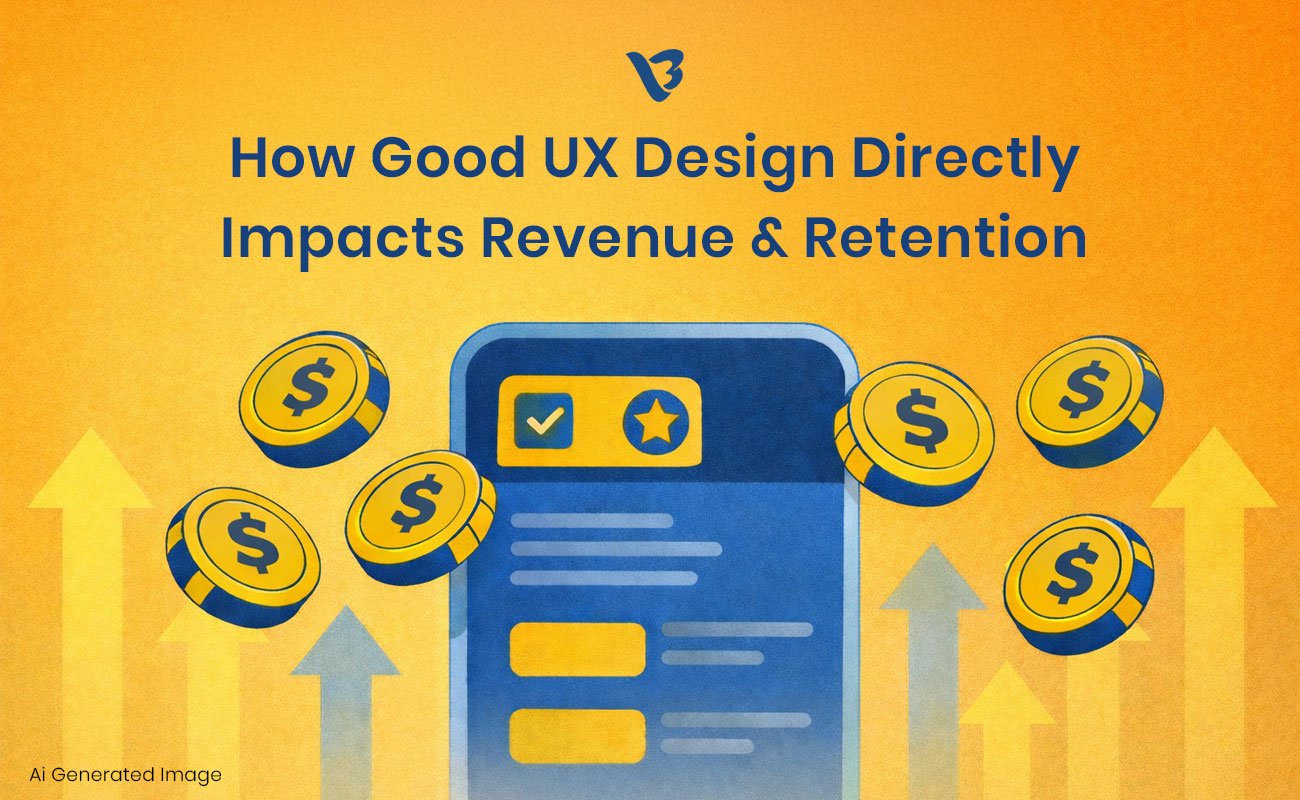
How Good UX Design Directly Impacts Revenue & Retention
A SaaS client came to us last year with a product their users genuinely liked. Engagement was decent, and sales were closing. But somewhere between acquisition and month three, users were quietly dropping off, and nobody could figure out why.
They had done the surveys, the exit interviews, the A/B tests. Nothing moved. By the time they reached us, they were ready to burn it all down and start fresh.
We told them to slow down. Before rebuilding anything, let us watch how people actually move through what you have.
New users were landing with high intent and hitting a wall within minutes. Navigation was built for insiders. Key actions were buried, progress felt invisible. They were not leaving because the product failed them; they were leaving because the experience never made them feel like they were succeeding.
We restructured onboarding, simplified the flows, and surfaced the right features at the right moments. Within two months, activation improved, and churn dropped. Nothing about the product changed. The experience did.
That is the gap most businesses miss. Revenue leaks quietly when the experience between intent and action is broken.
UX directly shapes conversion rates, lifetime value, retention and brand trust. The businesses that understand this treat it not as a finishing layer but as growth infrastructure.
In this piece, we break down exactly how UX impacts revenue, retention and everything in between.
How UX Directly Increases Revenue
1 Reduced Friction Improves Conversion
Every extra step a user has to take is a silent exit door. People don’t abandon products because they hate them. They abandon them because something got in the way. That friction is invisible to the team building it, but painfully obvious to the person experiencing it.
And friction is expensive.
- Clear navigation removes the guesswork. Users who cannot find what they need within seconds do not search harder, they leave.
- Streamlined checkout eliminates drop-off at the most critical moment. Forced account creation, hidden costs and excessive steps are conversion killers that show up clearly in the data.
- Optimized forms ask only for what is necessary, validate in real time and reduce the effort required to complete them.
- Logical information hierarchy ensures users always know what to do next without having to think about it.
2 Performance & Responsiveness Impact Buying Behavior
Speed is a UX decision, not just a technical one. Users do not experience slow load times as a server issue. They experience it as a product that does not work. A one-second delay in page load can drop conversions by 7%. By three seconds, a significant share of users is already gone.
Mobile makes this more critical. The majority of traffic is mobile, yet performance is still built for desktop first. A product that loads well on a laptop but struggles on a phone is quietly turning away a large portion of its audience. Fast, responsive experiences feel trustworthy. Slow ones feel risky, and users do not spend money where things feel risky.
3 Trust-Centric Design Drives Purchase Confidence
People do not need to understand design to feel when something is wrong. A layout that feels slightly off, a button that does not say what they expect, a price they were not told about until the last step. That feeling does not go away. It quietly becomes a reason not to buy.
Consistency, clear CTAs, upfront pricing, a layout that does not fight for attention. These are not UX design preferences. They are the things that make a user feel safe enough to hand over their money.
And when they feel that, they do not just buy once. They come back.
Also Read : 10 UI UX Design Mistakes to Avoid
How UX Improves Retention & Lifetime Value
1 Strong Onboarding Increases Activation
Most users decide whether a product is worth their time within the first few minutes. Not the first week, the first few minutes. A clunky onboarding, too many steps, no clear direction and they are gone before the product has shown them anything worth staying for. Get them to one meaningful win early and the dynamic shifts completely. That is not just good onboarding. That is where retention begins.
2 Ease of Use Builds Habit Formation
Products that are simple to use get used repeatedly. When a journey is clear and consistent, users build mental models fast. Those mental models become habits. Those habits become sticky. Friction inside a product does not just frustrate users, it breaks the habit loops that keep them coming back and pushes them toward alternatives that feel easier.
3 Emotional Experience Builds Loyalty
People do not stay for features. They stay because using the product feels good. The animation that responds just right, the flow that remembers where they left off, the small moment that makes the effort feel worth it. None of this makes a headline, but all of it makes a difference.
That is what loyalty is actually built on. And loyal users cost less to keep, spend more over time, and bring others in without being asked.
The Hidden Cost of Poor UX
Bad UX does not send a warning. It just costs you. Quietly, consistently, across every part of the business. Churn you chalk up to market conditions. Support tickets that keep piling up. Customers who bought once and never came back.
By the time it shows up clearly in the numbers, it has been bleeding for a while.
One user stuck on a basic task and raising a ticket is a design problem. Ten thousand users hitting the same wall is a revenue problem. Poor UX never shows up as a line item but you feel it everywhere else.
Measuring UX Impact on Business Growth
UX impact is not a feeling. It is measurable, and it shows up in numbers you are already tracking.
Conversion rate tells you if the experience is turning intent into action. Bounce rate tells you if people are leaving before they have even started. Retention rate tells you if the product is worth coming back to. Customer lifetime value tells you what a well-designed experience compounds into over time. Drop-off analysis, heatmaps, and usability testing tell you exactly where things are breaking and why.
Teams that track these stop having design conversations and start having growth conversations. That is the shift that happens when UX gets taken seriously.
Read about Leading UI/UX Trends Dominating
UX as a Strategic Investment
UX is not about making a product look modern. It is about making it work in a way that grows the business. It reduces the friction that costs conversions. It engineers retention through onboarding and emotional design. It shapes how users move, decide, and come back. In markets where every competitor has roughly the same features, experience is what tips the decision.
Companies that treat UX as an afterthought end up competing on price. Companies that treat it as infrastructure compete on loyalty.
UX is not a department. It is a growth system.
If your product is not converting the way it should, the experience is probably why. At Visual Best, we get into the details, find what is costing you and fix it. No fluff, just design that moves the needle. Let’s talk.
Work with Visual Best.
FAQs
1. What exactly is UX design and why does it matter for my business?
UX is how your product feels to use. It determines whether users convert, stay or leave. Get it wrong and no amount of marketing fixes it.
2. How do I know if my product has a UX problem?
Traffic is fine but conversions are flat. Churn is climbing with no clear reason. Support tickets keep repeating. Those are UX problems showing up in business numbers.
3. Can good UX really increase revenue?
Yes. Reduced friction lifts conversions. Better onboarding improves activation. Stronger trust increases transaction value. It all shows up in metrics you already track.
4. How is UX different from UI design?
UI is what users see. UX is what they experience. A product can look great and still lose users if the flows are confusing and key actions are buried.
5. How long does it take to see results?
Focused improvements to onboarding, checkout or navigation can show results within weeks. The client in this blog saw activation improve within two months.
6. Does UX only apply to apps and websites?
Any digital touchpoint where a user makes a decision. Website, product, landing pages, emails. Anywhere friction exists, UX can fix it.
7. My product is already live. Is it too late?
Most impactful UX work happens on live products. Real usage data gives you far more to work with than pre-launch assumptions.
8. What does Visual Best’s UX process look like?
We watch how users actually move through your product first. Then we find the friction, restructure the flows and make changes grounded in behavior, not guesswork.
9. How do you measure UX impact?
Conversion rate, retention rate, bounce rate, activation rate, drop-off analysis and customer lifetime value. Before and after, clearly tracked.
10. How do I get started?
Get in touch and tell us what is not working. We will take it from there.