Creative Operations , Strategy
Why High-Volume Creative Teams Should Work With One Studio (Not Five)

Look inside almost any enterprise marketing operation in India today and you’ll find a version of the same setup.
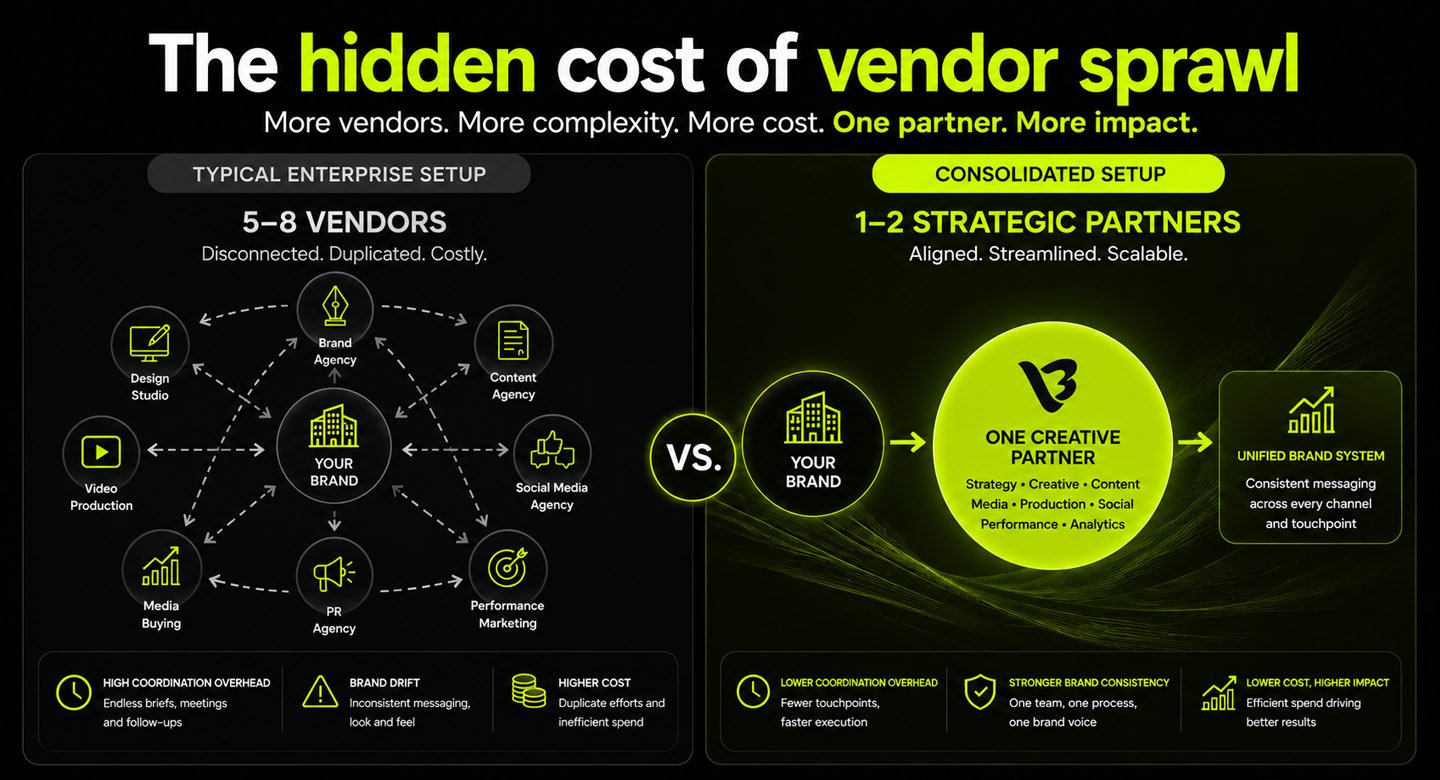
One creative agency handles presentations. Another does explainer videos. A third runs social media creative. A fourth manages the annual report. A fifth produces the brand campaigns. Sometimes a sixth for motion graphics, a seventh for AI content, an eighth for regional language variants. Each vendor was hired at a different moment for a different specific reason. Each brings its own project manager, its own workflow, its own tools, its own invoicing cycle, its own quarterly review meeting. Each requires a fresh brief every time you need work. Each has its own interpretation of your brand system.
The marketing lead running this operation spends roughly 12 hours a week on vendor coordination. The brand system drifts subtly across every touchpoint. Deadlines slip because handoffs between vendors fail. The annual creative budget looks efficient on paper because each vendor’s rate card seems competitive, until you calculate what you actually pay per usable creative asset. Then it looks like something quite different.
This is the vendor sprawl problem, and in 2026 it’s costing enterprise creative teams more than any other operational inefficiency in their function. The world’s largest brands are quietly moving in the opposite direction, and there’s a specific reason.
What’s changed in 2026: the great consolidation wave
Before the argument for consolidation, the market context worth knowing, because this isn’t a Visual Best opinion. It’s the direction the world’s largest advertisers are actively moving.
- Bayer moved its $752 million media and creative account to a single holding company partnership with IPG in 2025.
- Mars restructured its $1.7 billion global media roster into an integrated partnership with Publicis.
- Jaguar Land Rover consolidated its $500 million creative and media business with WPP.
- Microsoft put out an RFP explicitly requiring 80 percent of its business to be handled by just one or two holding companies.
- The Omnicom-IPG merger completed in late 2025 created the world’s largest single marketing services group, specifically to offer integrated solutions rather than fragmented specialist services.
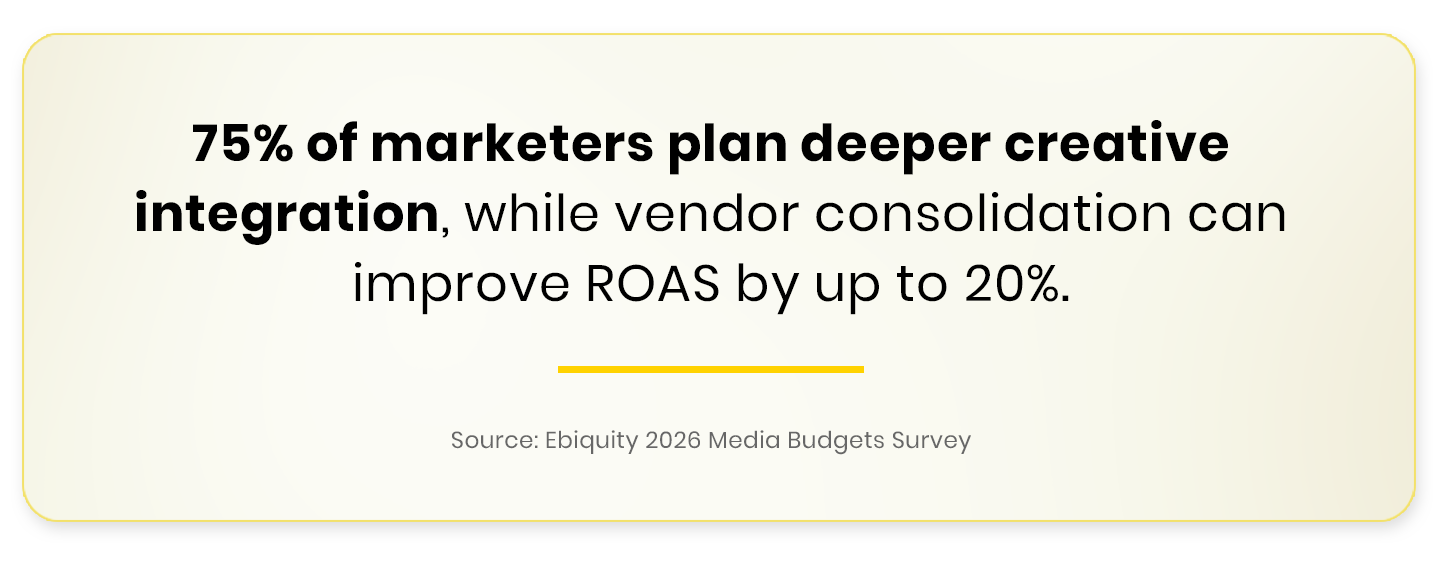
This isn’t a coincidence or a fad. The World Federation of Advertisers and Ebiquity 2026 Media Budgets Survey found that 75 percent of global marketers plan to drive deeper integration between media and creative in the coming year. The largest, most sophisticated buyers of creative services on earth have concluded that vendor fragmentation is a problem worth solving. Their reasoning applies to Indian enterprises just as much as to global ones.
The hidden costs of vendor sprawl (that most CFOs never see)
The rate cards are fine. That’s the trap. Each individual vendor looks competitive when evaluated on its own. The costs that break the vendor-sprawl model are invisible on any single invoice.
The coordination tax
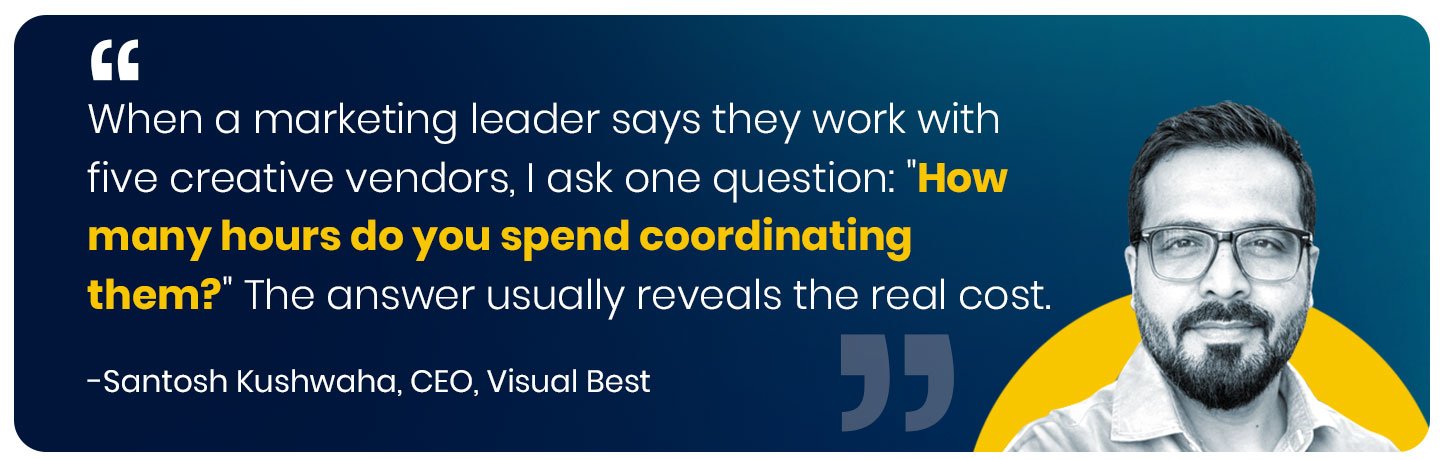
Every additional vendor adds roughly 3 to 5 hours per week of internal coordination time for the marketing team. Multiple vendors, multiple briefs, multiple review cycles, multiple invoices, multiple project managers to align with, multiple quarterly business reviews to sit through. A marketing lead managing five vendors typically spends 12 to 20 hours a week on pure coordination, before doing any actual marketing work.
At a mid-market marketing lead’s fully-loaded cost of ₹1.5 to ₹2.5 lakh monthly, that’s ₹40,000 to ₹70,000 of pure coordination overhead per month, absorbed silently into salary rather than the creative budget where it belongs.
The brand drift problem
Each vendor interprets your brand system slightly differently. The vendor doing decks uses one shade of your blue. The social team uses a slightly different one. The video team draws headings in a subtly different weight. The annual report team applies your logo with different spacing rules. Each individual asset looks fine. The complete brand ecosystem across all your touchpoints looks like it was made by different companies, because it was.
Brand drift isn’t visible on an invoice. It’s visible in the audience’s perception of your brand as “somewhat inconsistent,” which quietly erodes credibility over time.
The re-briefing cost
Every vendor gets briefed on your business from scratch. Each briefing takes 3 to 5 hours of your team’s time plus the vendor’s onboarding time. If you work with five vendors, you’re rebriefing your business context five times a year at minimum, more if any vendor churns. That’s institutional knowledge you’re paying to recreate over and over.
Consolidated vendors amortize that briefing across the full relationship. Fragmented vendors force you to pay for it repeatedly.
The handoff failure risk
When your annual report needs to feed social media content (see our related guide on this exact scenario), the handoff between two vendors introduces friction that often kills the workflow entirely. Source files don’t get shared. Brand context doesn’t transfer. Rights and permissions get confused. The intended repurposing dies in coordination cost, and the marketing team ends up producing content from scratch that already existed.
The invoicing and procurement burden
Five vendors means five contracts, five insurance certificates, five NDAs, five renewal cycles, five procurement reviews, five accounts payable relationships. Enterprise procurement teams increasingly see this as pure operational drag, which is exactly why the world’s largest brands are cutting their vendor lists.
What consolidation actually delivers (beyond just fewer invoices)
The naive version of the consolidation argument is “one vendor is cheaper than five.” That’s not quite right, and it’s not the main benefit anyway. The real gains are structural.
Brand system continuity that compounds
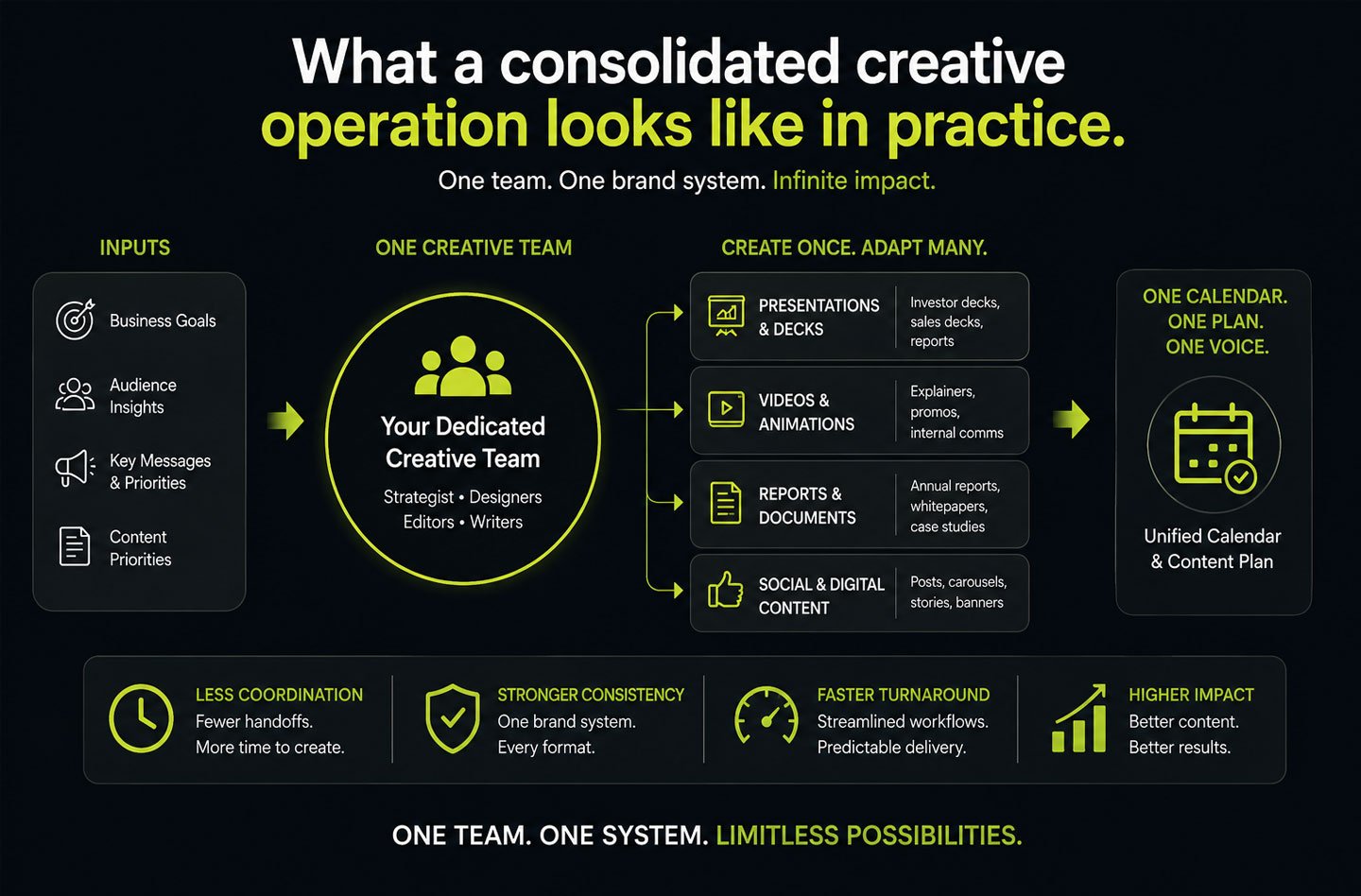
When one team owns your decks, videos, reports, and social work, the brand design system stays coherent across every touchpoint. The team that designs your presentation template also designs your social carousel template. Your video captions use the same typography as your report headers. This coherence isn’t a nice-to-have. It’s what makes a brand feel like a real brand rather than a collection of assets from different companies.
Cross-format repurposing becomes possible
The annual report actually feeds the social calendar. The presentation deck actually becomes the explainer video. The customer story from the annual report actually becomes the LinkedIn case study. Cross-format work that dies in a fragmented setup becomes routine in a consolidated one, which multiplies the effective output of every asset you produce.
Institutional knowledge stops leaking
The team knows your business. They know your CFO’s preferences, your CEO’s writing style, the products that always need extra care in review, the regional nuances that matter, the topics that make legal nervous. That knowledge takes 6 to 12 months to build with any vendor. Consolidated relationships keep it. Fragmented ones lose it every time a vendor changes.
Turnaround times compress
A team that already owns your brand system delivers a presentation refresh in 3 days instead of 3 weeks. A new social carousel takes hours instead of a full brief-review-revise cycle. Speed is a compounding benefit that most companies underestimate, because the cost of slow creative shows up as missed opportunities rather than as line items.
Strategic input enters the relationship
At five vendors each doing 20 percent of your creative work, no single vendor knows enough about your business to offer strategic input worth having. At one vendor doing 100 percent, they see the full picture. They can tell you when a proposed campaign will conflict with your brand system, when a format choice is wrong for your audience, when a timing decision will overload your production capacity. That strategic input is often worth more than the coordination savings.
The cost math actually works, once you count properly
Consolidated relationships typically deliver 30 to 50 percent lower cost per usable asset than fragmented ones, once you correctly count the coordination overhead, briefing costs, handoff failures, and brand-drift impact. Panache Consulting’s analysis shows up to 20 percent improvement in return on ad spend from vendor consolidation. That figure is at the conservative end of what we see with our own consolidated clients.

When you should NOT consolidate
The honest counter-argument that separates good advice from sales pitches. Consolidation isn’t always right. Three situations where five vendors genuinely beats one.
1. When your work is genuinely specialist across radically different domains
If your creative operation spans, say, industrial hardware CAD visualization plus performance marketing plus corporate identity plus 3D architectural rendering, no single studio credibly handles all of it well. Different specialisms require deep vertical expertise, and consolidating for the sake of it means accepting mediocrity in areas that need excellence.
The test: are the specialisms genuinely different (industrial CAD vs corporate identity vs performance marketing), or are they nominally different but actually adjacent (decks, video, social, reports, all of which are corporate creative work)? The first case wants specialists. The second case wants consolidation.
2. When you already have deep, functional relationships with specialists
If your existing creative design agency or vendor relationships are producing exceptional work, have deep institutional knowledge of your business, and coordinate well with each other, switching for the sake of consolidation is a mistake. The value of a mature vendor relationship is real and hard to replace.
The test: are your current vendors delivering consistently above expectations, or are you telling yourself they are while actually accepting mediocre work because switching feels hard?
3. When your volume is too low to justify a consolidated relationship
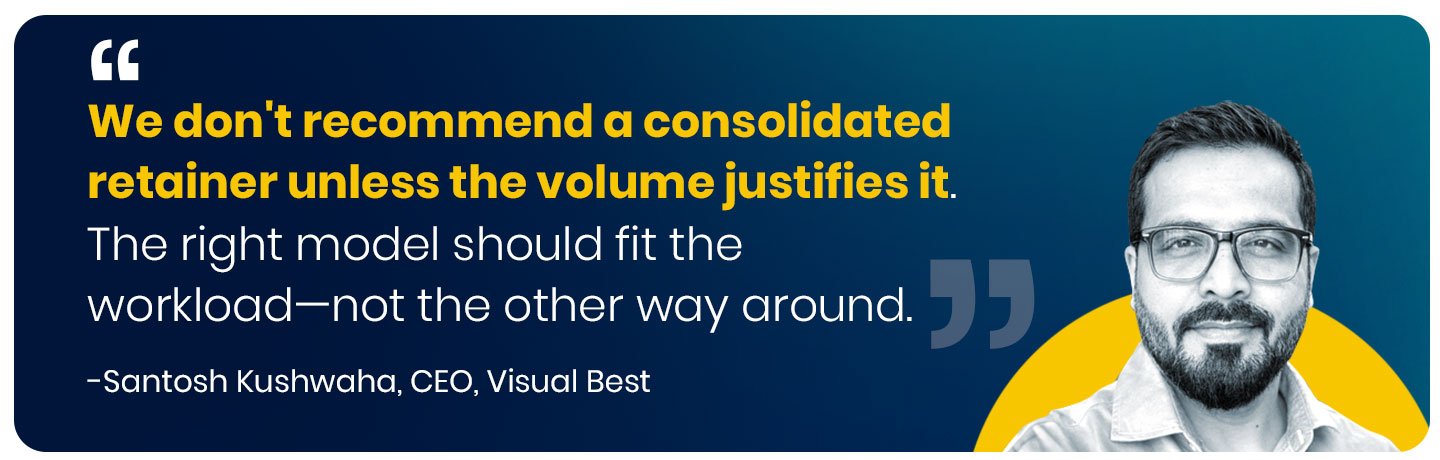
Consolidated relationships work best at meaningful monthly volume (say, 20+ creative assets per month across formats). If your creative needs are episodic (one deck a quarter, one video a year), project-based work with specialists is often the honest right answer. Consolidated retainers require enough volume to make the economics work for both sides.
The test: are you producing enough creative work monthly to feed a consolidated relationship, or would a retainer sit half-idle?
What good consolidation actually looks like
Assuming your situation genuinely calls for consolidation, the operational specifics matter. Not every “one-vendor” arrangement delivers the benefits above. Here’s what actually works:
Multi-format capability that’s real, not marketed. The vendor needs actual senior expertise across every format you need, not one strong specialty and four weak add-ons. Ask to see recent work in each format before signing.
A dedicated team, not a rotating pool. Consolidated relationships work when the same team owns your account continuously. If the vendor rotates account teams every quarter, the institutional knowledge advantage disappears.
A retainer model or long-term commitment, not one-off projects. The consolidation benefits require the vendor to build genuine understanding of your business. That takes 6 to 12 months and only makes sense in a commitment model.
Clear scope and exclusion boundaries. Get in writing what’s included in your monthly scope and what’s billed separately. Unclear scope is the failure mode of consolidated relationships.
Regular strategic reviews, not just delivery meetings. The strategic input benefit only materializes if you deliberately create space for it. Quarterly strategy sessions separate from delivery reviews are the standard model.
A defined exit clause. Consolidation creates lock-in risk. A fair notice period (60 to 90 days) protects both sides and keeps the relationship healthy through the natural evolution of the partnership.
The strategic question worth sitting with
For a CMO or head of marketing evaluating this, the honest question isn’t “should we consolidate,” it’s “does our current setup reflect a strategic choice or an accumulated accident?”
Most vendor sprawl isn’t strategic. It happens because vendors were hired sequentially over years, each for a specific reason at a specific moment. The team who signed the video vendor is no longer in the role. The reason for the separate presentation agency was resolved by a re-org three years ago. Nobody has taken a step back to ask if the whole shape of the vendor list still makes sense.
That step-back audit, done every 18 to 24 months, is what separates strategic marketing operations from accumulated ones. The audit itself is worth doing regardless of the outcome. Sometimes it confirms that your current setup is right. Sometimes it reveals that half your vendors could be consolidated tomorrow with substantial gains.
Either way, the answer is deliberate rather than accidental.

Frequently asked questions
How many creative vendors is too many?
There’s no universal number, but a signal to watch: if your marketing team spends more than 8 to 10 hours a week on vendor coordination, or if brand consistency is visibly drifting across touchpoints, your vendor list is likely too long for your team’s capacity.
Doesn’t specialization matter for creative work?
Yes, absolutely. But there’s a difference between deep specialization across radically different domains (industrial CAD vs corporate identity) and adjacent specializations across corporate creative work (decks, video, social, reports). The second category consolidates well; the first doesn’t.
What’s the risk of vendor lock-in with a consolidated model?
Real, but manageable. The mitigation is a fair notice period (60 to 90 days), a defined exit clause, and staged consolidation rather than moving everything at once. Never sign a 12-month exclusive contract with a new consolidated vendor. Start with a 3-to-6-month trial period.
How do I know if my current setup has vendor sprawl?
Three signals: your team spends more than 8 hours a week coordinating vendors, your brand looks visibly inconsistent across touchpoints, or your creative assets don’t flow between formats (annual reports don’t feed social, presentations don’t feed videos). Any one of these suggests fragmentation costs you’re absorbing.
Should I consolidate from five vendors to one, or from five to two?
Two or three vendors is often the right answer for enterprise operations, not one. One studio for creative production (decks, video, social, reports) plus one for something genuinely specialist (like performance marketing or PR). Full one-vendor consolidation only works for smaller organizations or for those with truly focused creative needs.
How long does consolidation take to show results?
Cost benefits appear in month 1 through reduced invoicing and coordination overhead. Quality and brand consistency benefits appear in months 2 to 4. Strategic input benefits appear in months 6 to 12 as the consolidated team develops deep business knowledge. Full compounding value takes about a year.
Isn’t this just an argument for hiring your agency?
Partially, yes. Visual Best benefits when clients consolidate to us. But the general argument is broader than any single agency, and the honest counter-arguments in this post reflect that. Sometimes consolidation is right and it isn’t Visual Best. Sometimes fragmentation is right regardless of who the vendors are. The framework matters more than the answer.
Related reading
- 📖 When Does a Creative Retainer Actually Make Sense?, the retainer decision framework, which is how consolidation typically gets structured.
- 📖 From Annual Report to Social Media Campaign, a specific example of what consolidation makes possible across services.
- 📖 Best Presentation Design Agencies in India 2026, the deck side of the multi-format equation.
- 📖 Top Graphic Design Agencies in 2026, the broader agency landscape.