Creative Retainer , Pricing , Strategy
When Does a Creative Retainer Actually Make Sense? A 2026 Buyer’s Decision Guide

Creative retainers are one of the smartest investments a B2B company can make. They’re also one of the easiest ways to waste a budget.
Both statements are true.
At Visual Best, we run creative retainers, so we have every incentive to tell you they’re the answer to everything. We won’t.
The reality is simpler: a retainer only works when a company is built to take advantage of it. Otherwise, even a great agency relationship can become expensive, frustrating, and underutilized. We’ve seen both outcomes firsthand, including clients who only realized the mismatch several months in.
This guide will help you spot the difference before you sign a contract, even if the conclusion is that you should stay project-based. Especially if that’s the right answer.
We operate both project-based and retainer models at Visual Best, so here’s our bias upfront: we sell retainers. We also regularly advise prospects against them when the fit isn’t right. This article explains why.
What a creative retainer actually is
Strip away the variations, and a creative retainer is a monthly fee that buys a defined band of creative output (decks, videos, reports, social, design support, or some mix), plus dedicated team access, priority turnaround, and continuity. The client pays whether they use every available hour or not.
The most common 2026 variants:
🔸 Hours-based retainer. A set monthly bank of hours (say, 40 or 80), the client can spend across any creative work. Flexible. Risks, scope drift, and “use it or lose it” pressure at month-end.
🔸 Deliverables-based retainer. A fixed monthly output (for example, 2 decks + 4 short videos + 6 social cuts). Easier to budget and forecast. Less flexible if needs shift.
🔸 Access-based retainer. A monthly fee for priority access to a creative team, with work billed against the retainer at preferential rates. Premium model. Best for companies that need agency availability more than agency hours.
🔸 Hybrid retainer. A base monthly fee covering a defined scope, plus a discounted hourly rate for anything beyond it. The most common shape in 2026 is usually the most balanced for both sides.
The right shape matters as much as the decision to retain at all. We’ll come back to this.
The honest answer: when retainers genuinely make sense
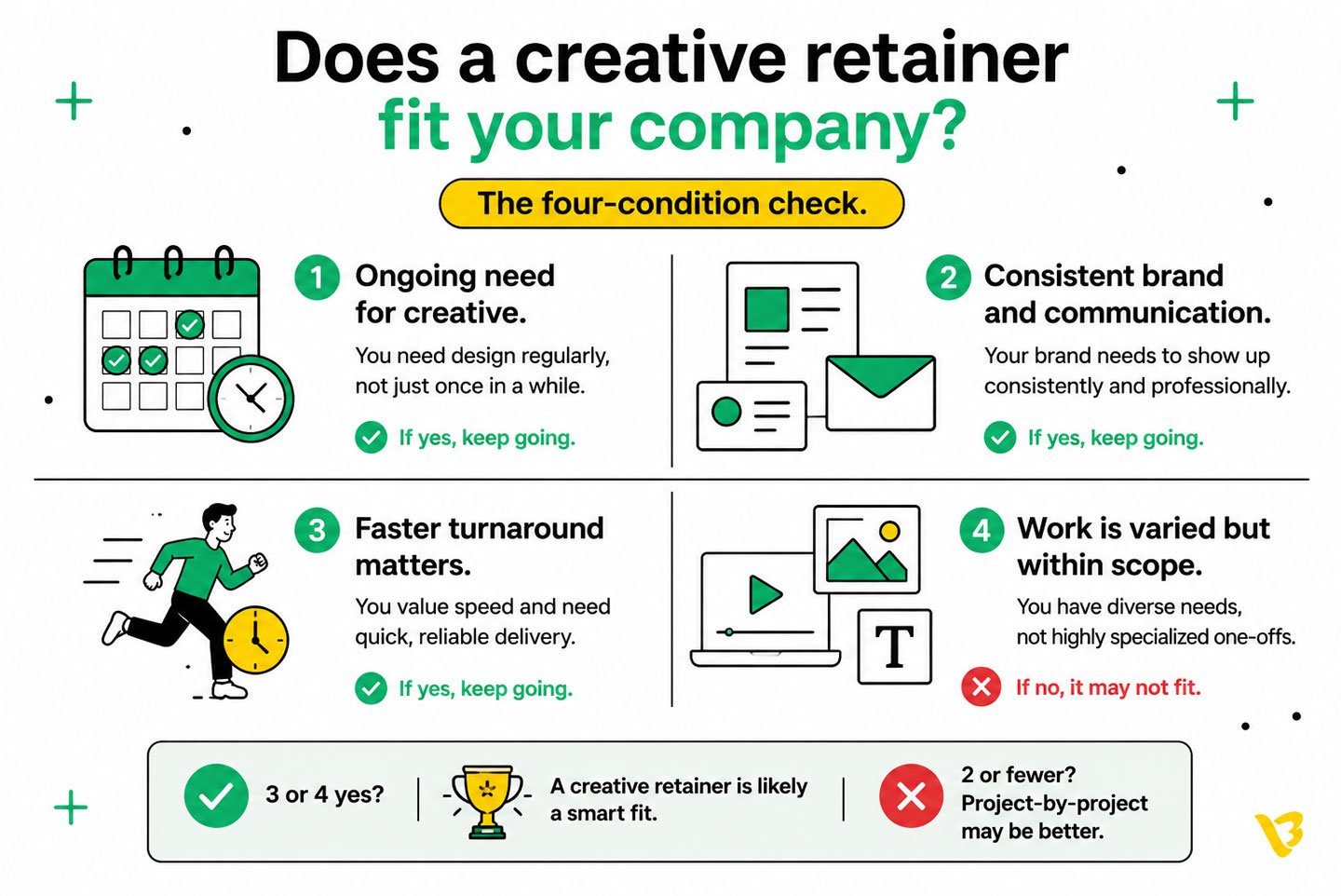
A retainer earns its place when four conditions are present together. Miss any one and the model starts to wobble.
1. Your creative needs are continuous, not episodic
If your team produces 4+ creative assets a month, every month, a retainer almost always saves money and time. If you produce 12 assets in a launch month and nothing for the next three months, project pricing is the honest fit.
The test: look at the last 6 months. If you can plot a roughly consistent monthly creative need, a graphic design retainer is in play. If your needs spike and fall, it isn’t.
2. The work covers a defined scope that you can describe in advance
Decks for the sales team. Short videos for social. Monthly newsletters. Performance creative for ads. Retainers work when the scope is broadly predictable, even if the specific briefs aren’t. They break when every brief is genuinely bespoke and high-strategy (“we need a brand refresh next month, but maybe a pitch deck, but maybe an investor video”). That’s project territory.
3. You have someone internal who can brief and approve fast
This is the condition most companies underestimate. A retainer’s value compounds when there’s a clear internal owner on your side who briefs cleanly, approves quickly, and feeds the team a consistent stream of work. Without that, the retainer hours sit idle while the team waits for direction, and you pay for capacity you didn’t use.
If your internal owner is busy, junior, or shared across too many priorities, a retainer will feel like an expense rather than an investment.
4. The cost math works at your volume
The simple math: a top-tier deck or video produced project-by-project costs X. The same deck or video produced inside a retainer typically costs 40 to 60 percent less per unit, because onboarding, briefing, and brand-system work amortise across more output. But that discount only materialises if you actually use the volume the retainer is sized for.
A ₹1,50,000 monthly retainer that produces 25 assets gives you assets at roughly ₹6,000 each. The same retainer producing 8 assets gives you assets at ₹18,750 each, often more expensive than buying them project-by-project. Volume is the lever.
When a retainer is the wrong call
Be specific about this, because it’s where most buyers get burned.
You’re a “few times a year” buyer
A pitch deck twice a year, a brand video annually, and a board deck quarterly. Total annual spend is real, but it isn’t monthly. Project pricing fits cleanly. A retainer just adds 6 to 8 months of idle fees with nothing to show for them.
Your work is mostly one big project, not many small ones
A brand refresh. A website rebuild. A flagship investor film. Defined start, defined end, owned by you when complete. Retainers force these into a monthly cadence that doesn’t match how the work actually happens.
Your team isn’t ready to brief consistently
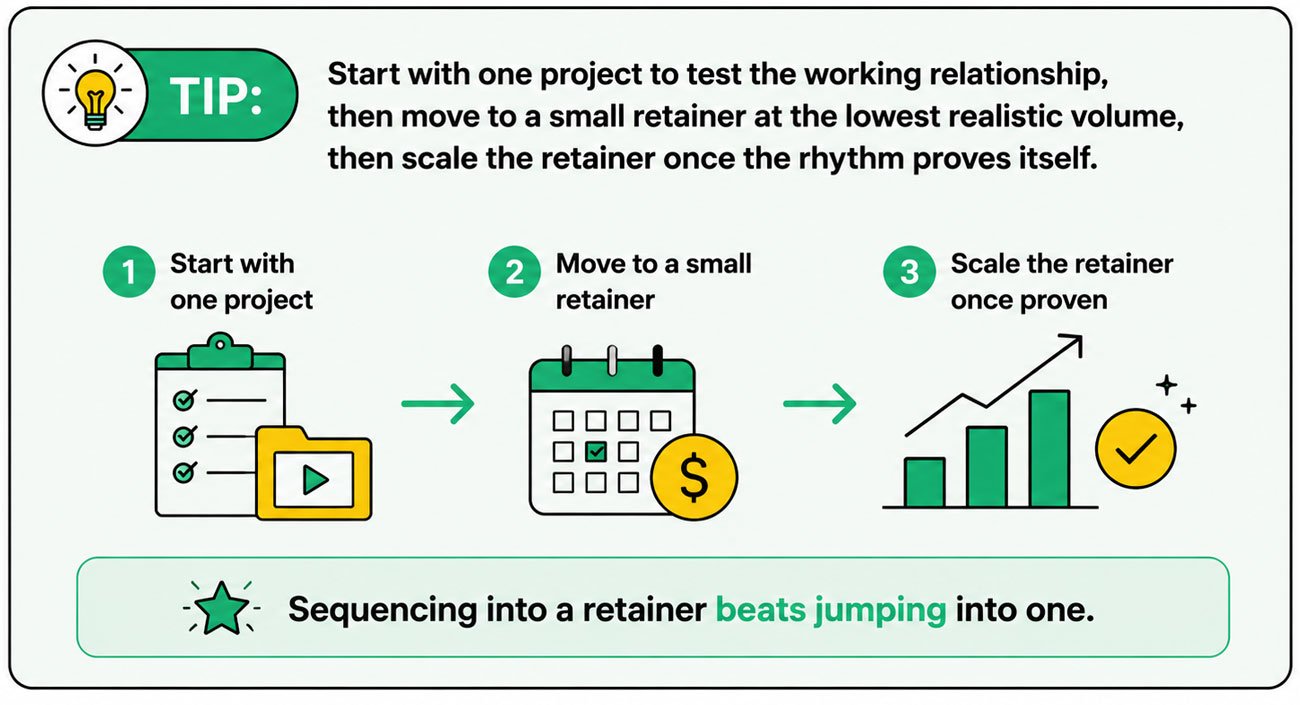
If you’re in early growth, between marketing hires, or going through a leadership change, you don’t yet have the internal rhythm a retainer needs. Wait. Run a few projects, build the working relationship, then re-evaluate.
You haven’t worked with the agency before
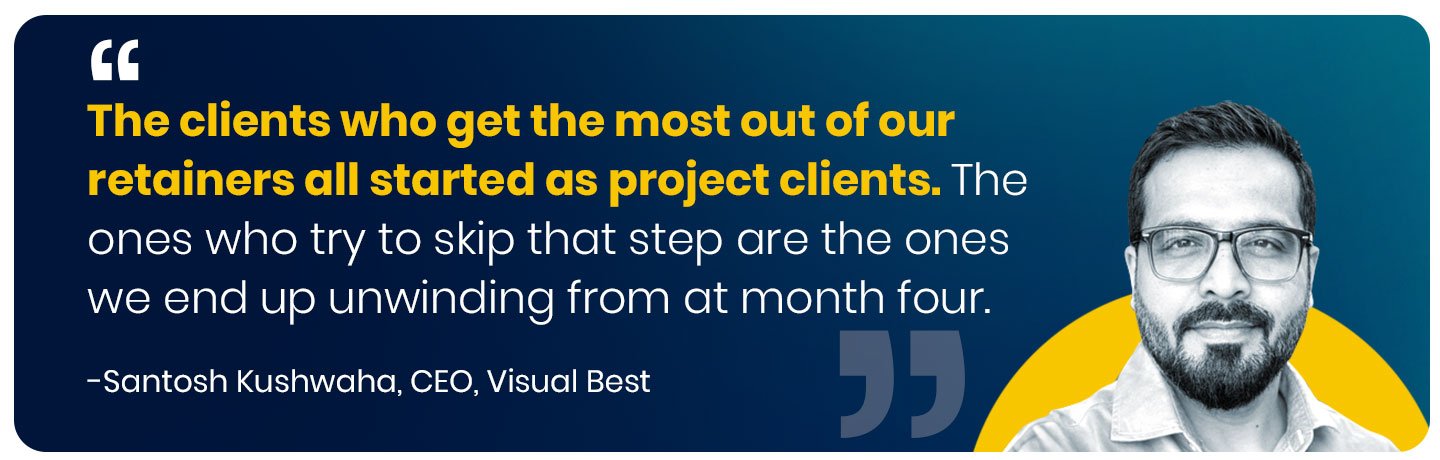
This is the trap. Signing a 12-month retainer with a new agency, before you’ve worked together, is committing to a relationship on a sales call. The smart sequence: run a project first, see the work and the working style, then talk to the retainer. Trust earns retainers. Sales pitches don’t.
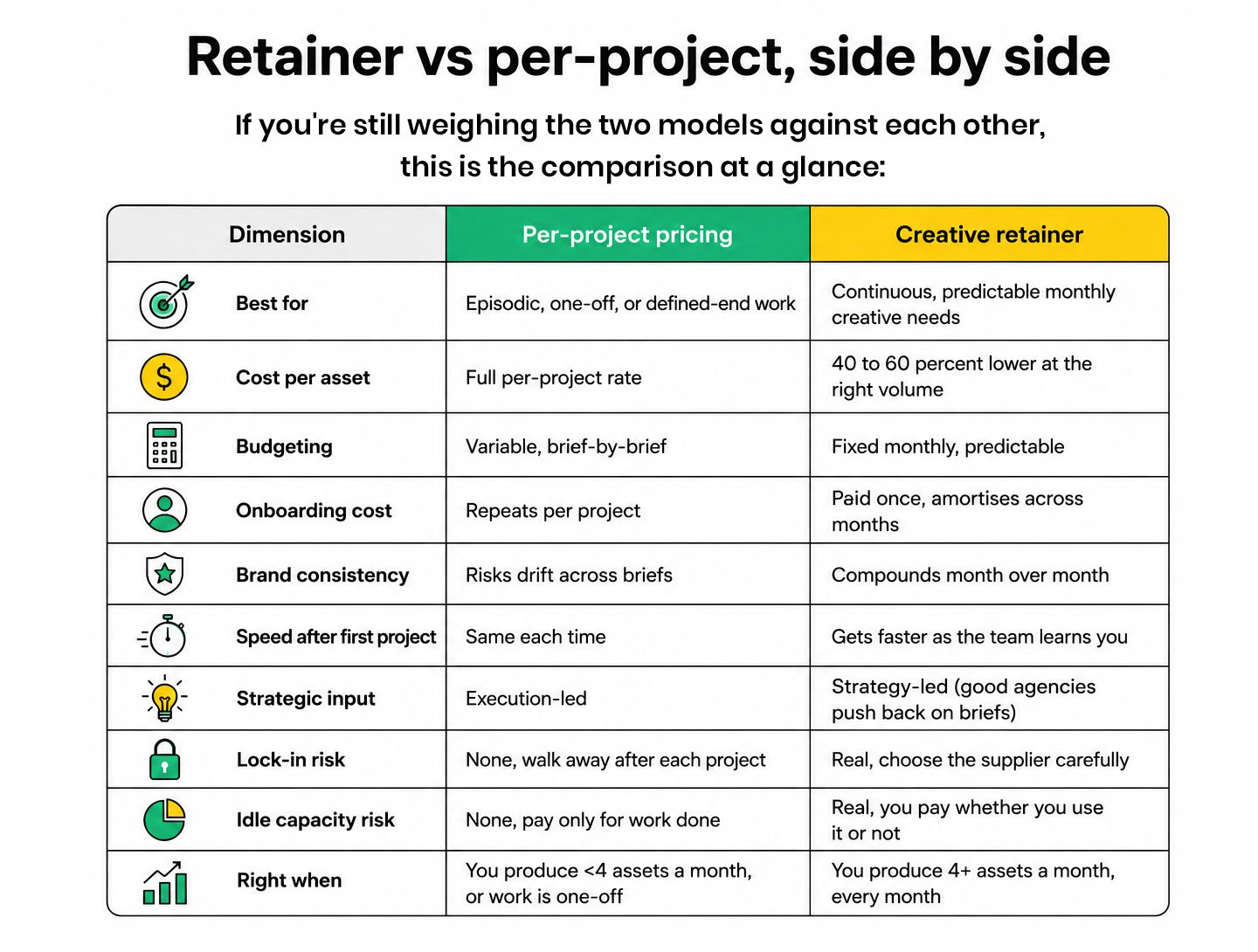
Notice the symmetry: every retainer advantage has a project-based equivalent disadvantage, and vice versa. The model isn’t better or worse universally, it’s better or worse for your specific pattern of creative spend.
A note on graphic design retainers specifically
Most buyers searching for this arrangement use the term “graphic design retainer” rather than “creative retainer,” so it’s worth being specific about what that shape looks like in 2026 and how it compares to the broader model we’ve been discussing.
A traditional graphic design retainer covered the obvious: logos, brochures, social graphics, basic collateral. In 2026 the scope has widened. Most graphic design retainer packages now include presentation design, short video and motion graphics, report and document design, and ongoing brand-system support, because that’s the actual creative spend pattern of a corporate marketing team. The retainer fee for graphic design at this expanded scope reflects the wider service, not the narrower 2015 definition.
Typical graphic design retainer packages in 2026 break into three tiers:
🔸 Entry tier (₹50,000 to ₹1,20,000 per month / $800 to $2,500). Aimed at SMEs and early-growth brands. Covers 15 to 25 hours of design work, suitable for ongoing social, sales collateral, basic presentation refreshes, and light brand maintenance. Best fit for companies just starting to centralise their design with one supplier.
🔸 Mid tier (₹1,20,000 to ₹3,00,000 per month / $2,500 to $6,000). The most common monthly retainer fee for graphic design at corporate scale. Covers presentation design, social and short-form video, report design, and dedicated brand-system upkeep. The right fit for marketing teams producing 8 to 15 assets a month.
🔸 Enterprise tier (₹3,00,000 to ₹6,00,000+ per month / $6,000 to $15,000+). Hiring a graphic designer on retainer at this tier effectively gives you a small dedicated team: a senior designer, junior support, project management, and priority access. Right fit for listed companies, large enterprises, and any brand producing 20+ assets monthly across multiple formats.
What’s typically included in monthly retainer graphic design charges: the design hours themselves, dedicated project management, brand-system maintenance, and 2 to 3 revision rounds per asset. What’s typically excluded and billed separately: stock licensing, professional voiceover and music for video work, multi-language adaptations, and rush turnarounds. As with any creative arrangement, get the inclusion list in writing.
The “creative retainer” framing in the rest of this guide covers everything in graphic design retainer packages and more (with explainer video production, annual reports, and strategy work added). If your needs are design-heavy and video-light, lead with a graphic design retainer scope. If they’re multi-format from the start, the broader creative retainer shape fits better.
Which deliverables should sit inside a creative retainer (and which shouldn’t)
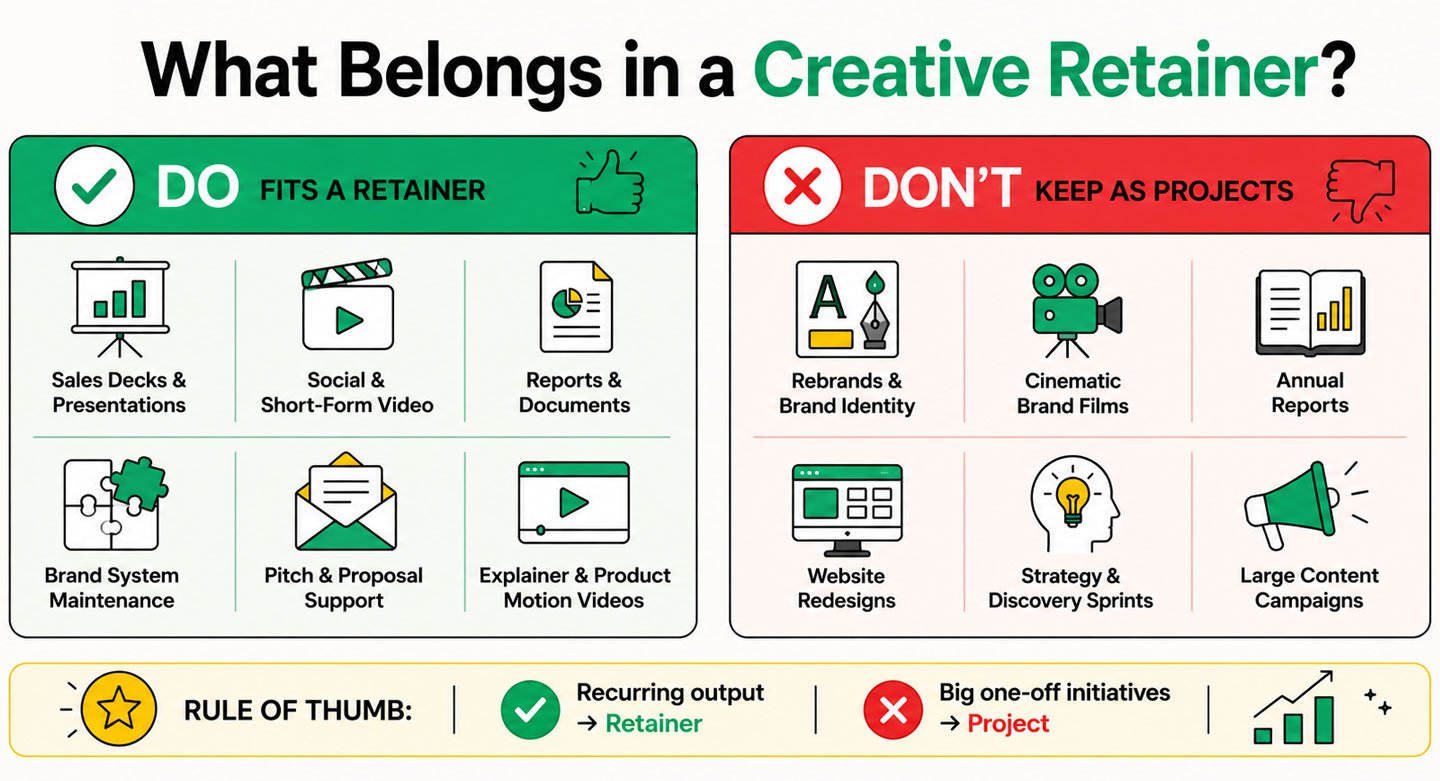
Once you’ve decided a retainer fits, the next question is what to put inside it. Not every deliverable belongs there. Some compound beautifully under a retainer model. Others actively waste it.
The rule: deliverables that benefit from continuity, repetition, and accumulated brand knowledge belong in the retainer. Deliverables that are bespoke, episodic, or strategy-heavy usually don’t.
Fits a retainer well
🔸 Recurring presentations and sales decks. A sales team that needs 3 to 5 tailored decks a month is the canonical retainer use case. The first deck is slow; the tenth is fast, because the team owns your template, voice, and category context. Per-deck cost falls sharply over time.
🔸 Social and short-form video output. Continuous social content (LinkedIn carousels, short videos, motion graphics) is the most over-priced deliverable in the project-based model and the most under-priced inside a retainer. If you publish weekly, this belongs in the retainer.
🔸 Brand-system upkeep. Templates, master decks, brand guidelines, asset libraries. These need continuous tending, not one-off creation. A retainer puts them in the hands of a team that updates them monthly instead of letting them rot for a year before the next rebuild.
🔸 Ongoing report and document design. Quarterly investor updates, monthly board decks, internal newsletters, periodic case studies. Anything that recurs on a calendar fits a retainer model cleanly.
🔸 Pitch and proposal turnaround. Sales teams that need quick design support on RFPs and tailored pitches benefit enormously from a retainer’s priority access. A project-based studio can’t turn a custom proposal deck around in 36 hours. A retainer team can.
🔸 Standard explainer videos and product motion content. If you produce a few short-form explainer or product videos a month at consistent quality, these compound well inside a retainer (especially with a brand-system already in the team’s hands).
Doesn’t fit a retainer (keep these as projects)
🔸 Brand identity and rebrands. Logo systems, brand strategy, full brand identity work. These are heavy, defined, one-off projects with clear start and end states. A retainer flattens them into monthly chunks that don’t match how the work actually happens. Run as a separate project, then let the retainer maintain the system afterward.
🔸 Flagship investor films and cinematic brand films. Multi-day shoots, named directors, six-figure productions. Too large and too discrete to absorb into a monthly fee. Project pricing protects both sides.
🔸 Annual reports and large brand films. Annual reports are an interesting edge case. The production is genuinely project-shaped (defined deliverable, clear deadline, large effort window). But the brand-system work that supports it belongs in the retainer. Most strong arrangements treat annual reports as a separately-scoped project that draws on the retainer team for continuity, not a retainer line item.
🔸 Website rebuilds and large content campaigns. Same logic, big defined deliverables with clear end states. Keep them as projects.
🔸 Strategy work and discovery sprints. Workshops, narrative strategy intensives, brand positioning work. Best billed by sprint or project, because the value is in the depth and ownership of the moment, not the hours spent.
The hybrid most companies actually need
The cleanest 2026 arrangement we see work is a retainer for the continuous output, plus project-based pricing for the heavy one-offs, with the same studio doing both so the brand system stays coherent. The retainer handles the monthly volume. Projects handle the launches, the rebrands, the investor films. The studio that runs your retainer is also the studio that delivers your big-bang work, because that continuity is exactly the compound value the retainer was supposed to buy in the first place.
The decision framework
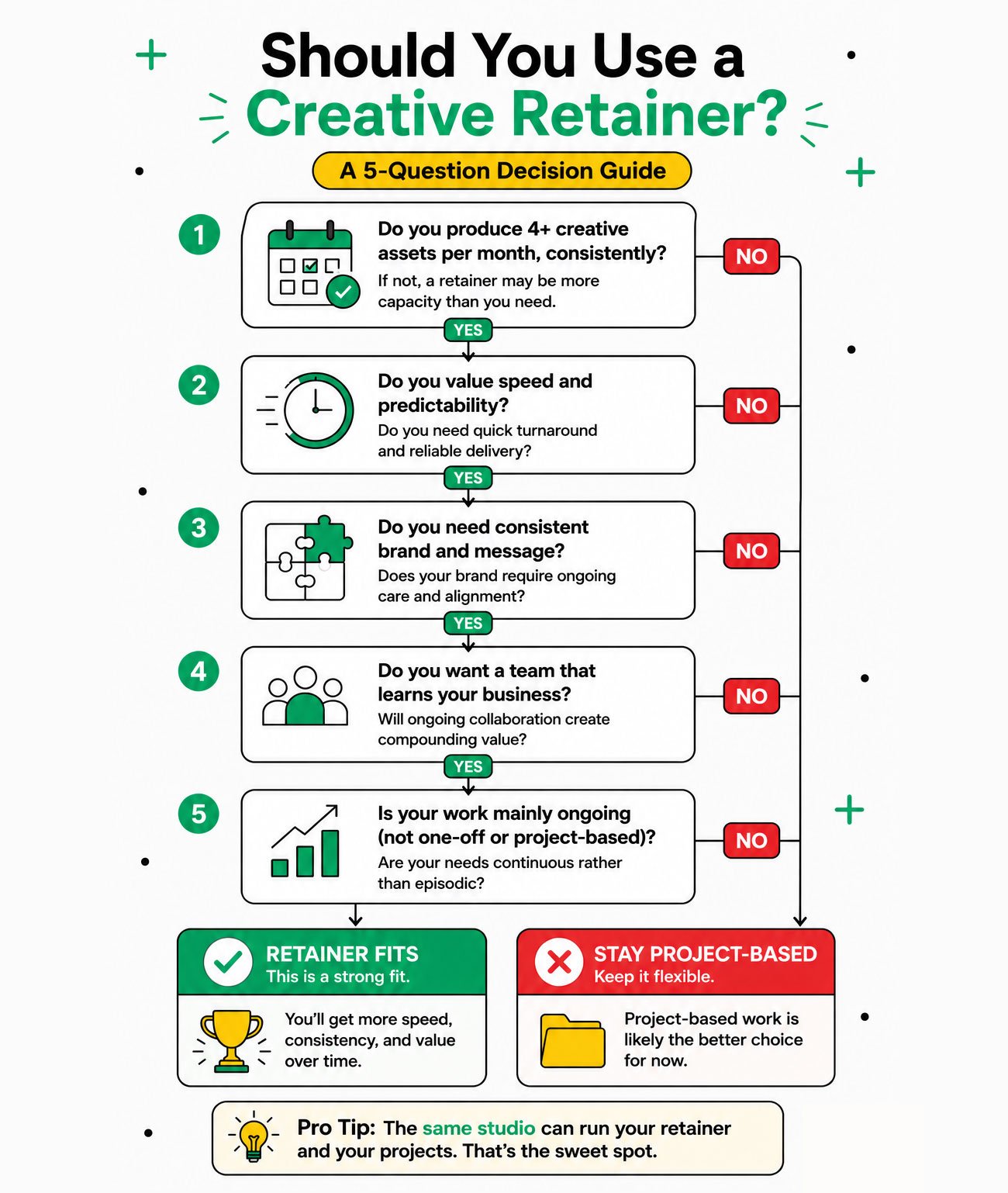
Five questions. Answer them honestly:
- Do you produce 4 or more creative assets a month, every month? Yes, retainer is in play. No, stay project-based.
- Can you describe the rough scope and volume of next quarter’s creative work in advance? Yes, retainer fits. No, projects fit better.
- Do you have a clear internal owner who can brief and approve weekly? Yes, retainer will work. No, hire that owner before you hire the retainer.
- Have you worked with the agency on at least one project before? Yes, retainer is a sensible next step. No, start with a project.
- Are you willing to use the retainer’s full capacity each month? Yes, the cost math works in your favour. No, you’ll quietly pay for unused capacity.
If you answered yes to all five, a retainer is likely the highest-ROI creative arrangement you can sign in 2026. If you answered no to two or more, stay project-based for now.

Projects build proof. Retainers build businesses.
The smartest framing we’ve heard on this: projects build proof, retainers build businesses. Projects prove an creative agency can do the work; retainers turn that proven relationship into compounding value over time, in ways a series of disconnected projects can’t.
What you get inside a retainer that you don’t get from projects:
🔸 Brand-system continuity. The team learns your voice, your visual rules, your industry quirks, your edge cases. Outputs get more on-brand month after month because the system is in their hands, not relearned each brief.
🔸 Compounding speed. A first deck takes three weeks. By the sixth, it takes a few days, because the template, voice, and shared shorthand are already built.
🔸 Strategic input, not just execution. Project agencies execute briefs. Retainer agencies (the good ones) push back on them, because their incentive is your sustained outcome, not the invoice on this specific brief.
🔸 Real cost reduction per asset. As covered above: 40 to 60 percent per-unit savings at the right volume.
🔸 Capacity when you actually need it. The week before a board meeting, the night before an investor pitch, the morning of a launch. A retainer team picks up the phone. A project team is on someone else’s brief.
The flip side is real too. Retainers lock you to one creative supplier, which is exactly what makes them powerful when the supplier is right, and exactly what makes them painful when the supplier is wrong. Which is why the “have you worked with them on a project first” rule matters more than any other.

How to structure a retainer that actually works
If you’ve decided a retainer fits, structure matters as much as the decision itself. Three rules we’ve learned from running retainers across decks, videos, and reports:
Rule 1: Start small, then scale. Sign a 3-month retainer at the lowest realistic volume first. If the rhythm works, expand. Most failed retainers were oversold at the start; the ones that compound were undersold and grew.
Rule 2: Pick a hybrid shape unless you’re certain about volume. A base monthly fee covering core scope, plus discounted rates for anything beyond, gives both sides flexibility. Pure hours-based retainers create month-end “use it or lose it” pressure that produces busywork. Pure deliverables-based retainers can’t flex when needs shift.
Rule 3: Build in a quarterly review. Every 90 days, both sides review: what was used, what wasn’t, what should change. Without it, the retainer drifts. The good ones evolve every quarter.
One thing to avoid: long lock-ins. 12-month no-exit contracts protect the agency, not you. A monthly or quarterly notice period is fair to both sides. If a studio insists on annual lock-in upfront, that tells you something about their confidence in the relationship lasting.
Frequently asked questions
1. When does a creative retainer make sense for a company?
When you produce 4+ creative assets a month consistently, have a clear internal owner to brief, and have already worked with the agency on a project. Without those three, project pricing is usually the better fit.
2. How much should a creative retainer cost in 2026?
Typical 2026 monthly creative retainers run from $1,000 to $25,000+ globally, and ₹1,50,000 to ₹6,00,000+ in India, depending on scope, volume, and seniority. Hybrid retainers (base fee plus flex hours) are the most common shape.
3. What’s the typical retainer fee for graphic design in 2026?
Most graphic design retainer packages run ₹50,000 to ₹3,00,000 per month in India (roughly $800 to $6,000 globally) for SME and mid-market scope, with enterprise-tier packages reaching ₹6,00,000+ per month. Monthly retainer graphic design charges in 2026 typically cover design hours, project management, brand-system upkeep, and a defined revision cap.
4. Are retainers cheaper than project-based work?
Per asset, yes, often 40 to 60 percent cheaper, if you use the volume the retainer is sized for. If you don’t, retainers cost more per asset than project work. Volume is the lever that makes the math work.
5. Should I sign a retainer with an agency I haven’t worked with before?
No. Run a project first, see the work and working style, then talk retainer. Trust earns retainers; sales pitches don’t.
6. What’s the difference between a retainer and project pricing?
Project pricing sells a specific result with a defined start and end. Retainer pricing sells an ongoing relationship and continuous access to a team, billed monthly regardless of specific output. Most strong 2026 agency relationships use both: projects to start, retainers to grow.
7. What’s the most common retainer shape in 2026?
Hybrid retainers: a base monthly fee covering core scope, plus discounted rates for additional work beyond it. The shape balances predictability for the agency with flexibility for the client.
8. How long should a retainer contract be?
3 to 6 months as a starting term is fair. Avoid 12-month lock-ins from a new agency, especially without a clean exit clause. Quarterly review cycles are the 2026 standard.
Related reading
- How a Graphic Design Retainer Saves Time & Reduces Costs, the blog tells about how to reduce the cost of retainer services for businesses that need ongoing or frequent designs.
- Presentation Design Cost in India 2026, the deck side of the creative budget.
- Best Explainer Video Companies (India + Global) 2026, how to shortlist a studio before talking retainer.
- Can AI Presentation Tools Replace a Design Agency in 2026?, the AI vs human question, which retainers help resolve.