Explainer videos , Pricing , Strategy
Explainer Video Cost in 2026: India + Global Pricing Guide for Corporate Buyers
You send the same brief to three studios. The quotes come back at ₹30,000, ₹1,50,000, and ₹3,50,000.
Same 90 seconds. Same product. Same deadline.
Which is fair? Which is a rip-off? And the question nobody asks aloud is which one will quietly underperform and waste both the money and the moment?
If you’ve ever stared at a video production quote wondering whether you’re paying for the work or for someone’s office in Bandra, this guide is built for you. We produce explainer videos across every format, animated, live-action, 3D, hybrid, and AI-assisted for clients across India and globally. Here’s exactly what it costs in 2026, why the ranges are what they are, and what’s worth paying for.
The benchmark most Indian SMEs and growing brands land at: ₹60,000 to ₹2,50,000 for a single professional explainer. Investor-facing or brand-critical work typically sits ₹2,50,000 to ₹5,00,000.
Why is the range so wide?
Quotes for the “same” video can swing 20x because no two studios are actually quoting the same work. Five factors do most of the moving.
1. Format chosen
A whiteboard animation costs a fraction of a 3D product film, and a one-day live-action shoot costs a fraction of a multi-day cinematic brand piece. The format is the single biggest pricing lever and it’s often the wrong place clients start.
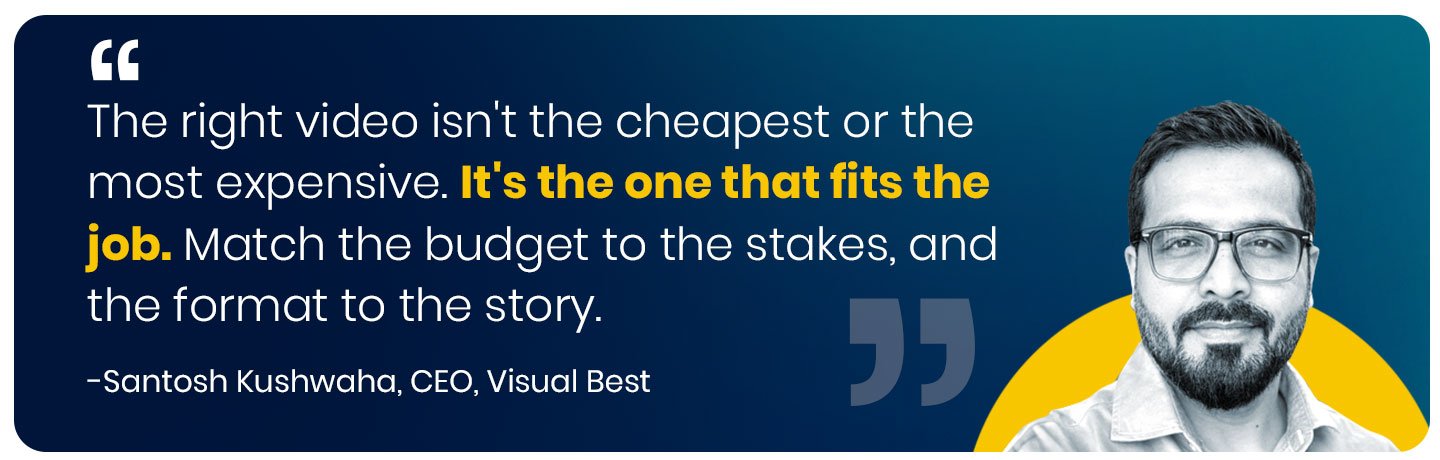
Choose the format that fits the story, not the budget. A ₹40,000 motion-graphics piece that tells the story well outperforms a ₹3,00,000 3D piece that doesn’t.
2. Production scope
Custom characters, multi-location shoots, original music, professional voice talent, multiple language versions, drone footage, talent licensing each stack the bill. Stripped-down briefs (single voice, stock music, one location, no characters) are exponentially cheaper than full-scope productions.
3. Length and number of variants
A 30-second video costs less than a 90-second one but more importantly, one 90-second hero plus 6 short cut-downs for social costs much less than producing seven separate videos. The 2026 best-practice budget produces a single core asset and generates multiple platform-specific variants from it.
4. Turnaround time
Rush jobs (48–72 hour delivery) carry a 25–50% premium in India, and a true overnight rush can push 100%+ at top studios. Two weeks of lead time is the threshold where pricing normalises.
5. Revisions and rounds
Most studios include 2–3 revision rounds. Beyond that, additional rounds are billed hourly (₹1,000–₹2,500/hour in India). “Unlimited revisions” in proposals is rarely actually unlimited read the fine print.
What you should actually budget by use case
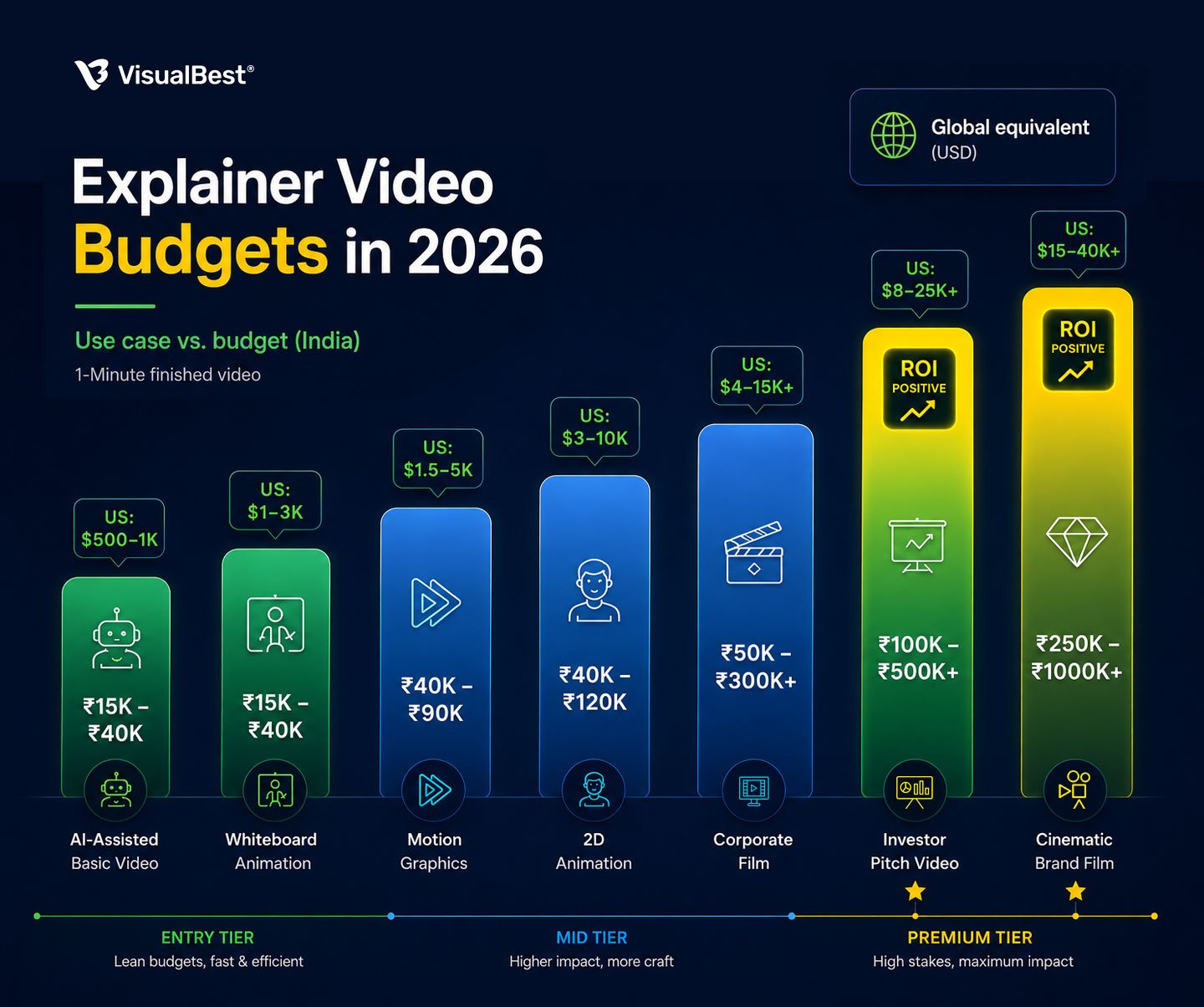
Different videos demand different investments. Realistic 2026 spend for the most common corporate video use cases:
Internal / training videos
Budget: ₹15,000 – ₹75,000 | Global: $500 – $3,000
AI-assisted, whiteboard, or basic motion graphics. Function over flash. Don’t overspend here.
Social and product explainers
Budget: ₹60,000 – ₹2,00,000 | Global: $2,000 – $5,000
Motion graphics or 2D animation, 60–90 seconds, with social cut-downs. The workhorse format for most B2B explainer needs.
Investor pitch supporting videos
Budget: ₹1,50,000 – ₹3,00,000 | Global: $5,000 – $15,000
High-stakes, brand-critical. Custom animation or hybrid live + animation. Worth investing in these videos, which sit alongside your pitch deck and influence funding outcomes.
Live-action corporate film (founder, culture, leadership)
Budget: ₹1,50,000 – ₹5,00,000 | Global: $6,000 – $20,000
Professional crew, single or two-day shoot, proper post-production. Where authenticity is the point and animation can’t deliver it.
3D product animation
Budget: ₹1,00,000 – ₹3,00,000+ | Global: $5,000 – $30,000+
Hardware, industrial, FMCG, complex SaaS interfaces. The premium tier and the right call when the product genuinely benefits from spatial visualisation.
Cinematic brand film / national campaign
Budget: ₹2,50,000 – ₹10,00,000+ | Global: $15,000 – $40,000+
Multi-day shoots, professional talent, broadcast-grade finish. For launches, TVCs, and major brand statements.
Short-form video retainer (10–15 videos/month)
Budget: ₹60,000 – ₹1,50,000/month | Global: $2,500 – $5,000/month
The fastest-growing model in India 2026 is predictable monthly spend for continuous social and short-form output. Cheaper per video by 40–60% versus one-offs.

Why Indian production costs so much less (and the quality gap, honestly)
The India-vs-global gap is real, large, and the most important number in this guide for any global buyer.
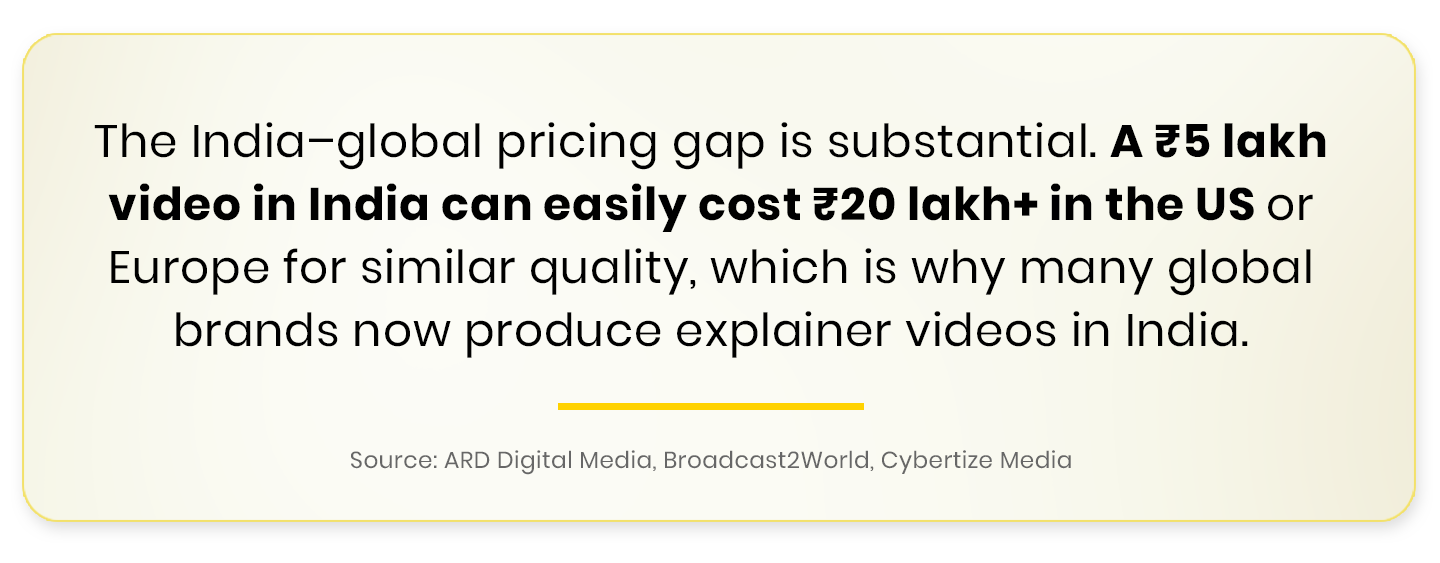
Why the gap exists: lower talent costs, lower operational overhead, a deep animation talent pool (India has been the back-office for global animation for decades), and a competitive domestic market that keeps quotes honest. Same software, same skills, dramatically different cost structure.
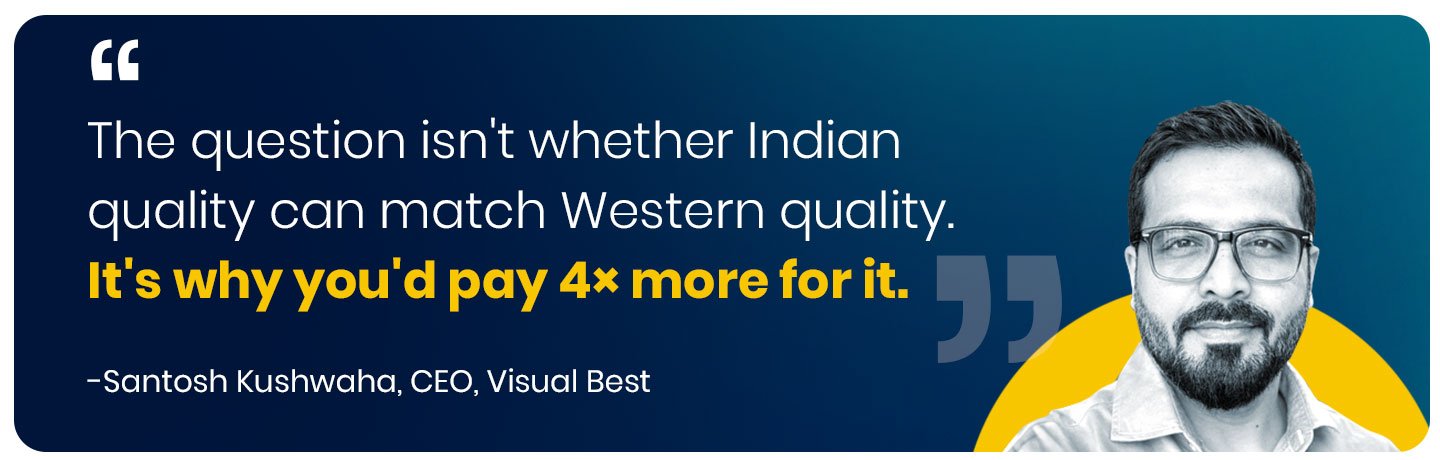
Where the gap has closed: at the top-tier specialist Indian studios producing investor films, brand campaigns, and 3D product animation now deliver at international standards. The visible quality difference between a top Indian studio and a top US/UK studio in 2026 is small to non-existent.
Where the gap hasn’t closed: at the bottom tier. Cheap Indian freelancers and budget studios produce work that’s visibly cheaper, with generic visuals, formulaic scripts, and weak post-production. The savings are real; the credibility cost is also real.
The practical implication for global buyers: pay top-tier Indian rates (₹2L–₹8L for a serious video) and you’ll get work indistinguishable from a $50K Western production. Pay bottom-tier (₹15K–₹40K) and you’ll see exactly why it was cheap. The middle is the right zone for most corporate work.
Hidden costs most quotes don’t mention
This is where buyers get blindsided after signing:
🔸 Voiceover talent. Professional VO in India: ₹5,000–₹30,000. International VO (UK, US, neutral accent): $300–$1,500.
🔸 Music licensing. Stock-music pass-through: ₹2,000–₹15,000. Custom-composed score: ₹25,000–₹2,00,000+.
🔸 Talent and usage rights. A video for LinkedIn and a video for national TV use the same shoot, but different licensing TV/broadcast rights can multiply talent costs 3–10x.
🔸 Multi-language versions. Each language version (Hindi, Tamil, Spanish, etc.) typically adds 30–60% to the base cost, separate VO, subtitle adjustments, and sometimes localised graphics.
🔸 Format adaptations. Vertical/horizontal/square versions of the same video are often billed separately. The 2026 best practice (one production, many cut-downs) should be priced into the base quote confirm upfront.
🔸 Rush fees. 25–50% on top of base for tight turnarounds. 100%+ for true overnight.
🔸 Extra revisions. Past included rounds (usually 2–3), expect ₹1,500–₹3,500/hour in India.
🔸 Source files/project files. Some studios deliver only the final MP4 and charge for editable project files. Always confirm.

How to pick the right budget tier
Three quick filters:
🔸 Stakes: Is this video tied to a deal, a round, a launch, or just an internal update? Premium for high-stakes; basic for routine.
🔸 Story: Which format does the story actually need? Don’t pay for 3D when 2D tells it better; don’t settle for stock when authenticity is the point.
🔸 Volume: One-off video, or ongoing need? For 4+ videos a year, a retainer slashes per-video cost.
The mistake to avoid: buying up on the production tier when the story doesn’t justify it. A polished 90-second motion graphics piece outperforms an over-produced cinematic film for most corporate explainer jobs.
Frequently asked questions
1. How much does an explainer video cost in India in 2026?
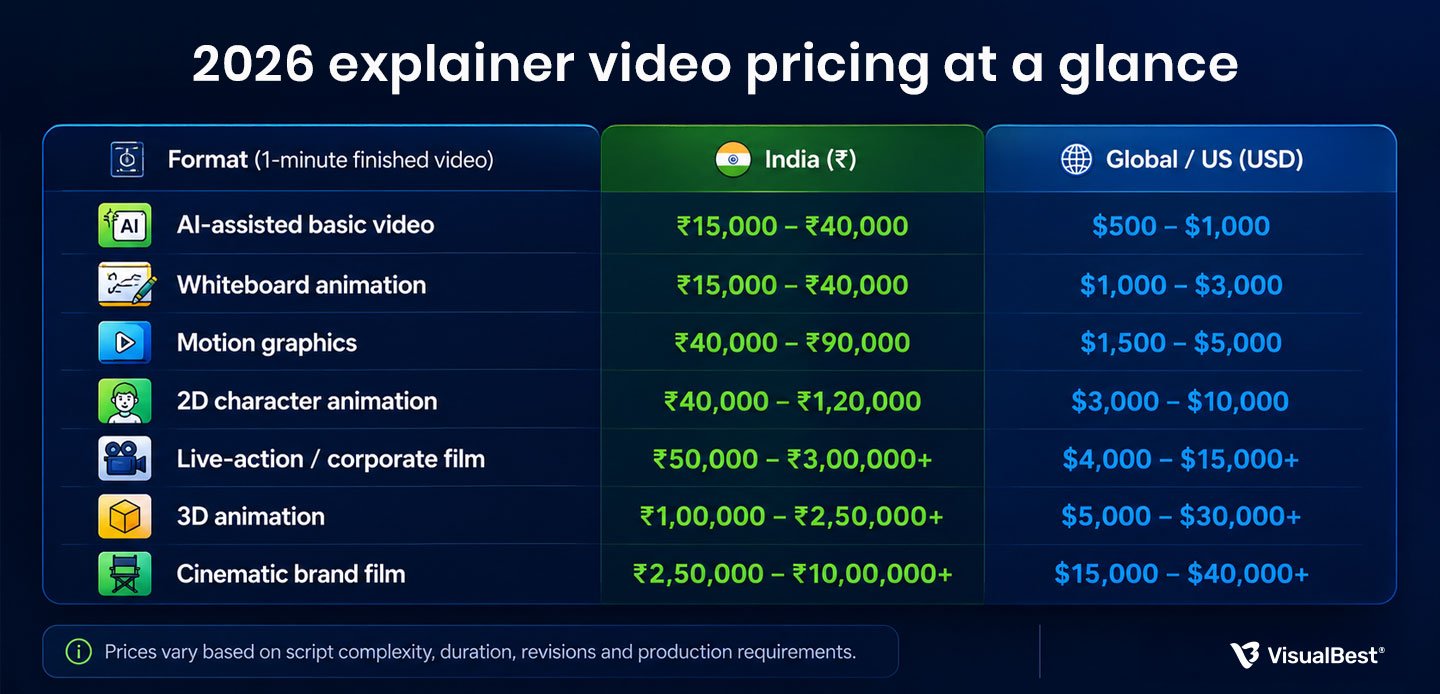
Anywhere from ₹15,000 to ₹10,00,000+ depending on format, length, and complexity. Most corporate buyers spend ₹60,000–₹2,50,000 for a single professional explainer. Investor-facing or brand-critical videos typically run ₹2,50,000–₹8,00,000.
2. Is animation or live-action cheaper for a corporate video?
For short videos (60–90 seconds), animation is often cheaper than a live-action shoot with full crew and locations. For longer videos or anything requiring real people, live-action is usually more cost-effective than complex animation. Match format to story, not to budget alone.
3. How much does a 1-minute 2D explainer video cost in India?
Typically ₹40,000–₹1,20,000 for a professional studio-produced 2D character animation, including script, voiceover, and music. Motion graphics start lower (₹40,000–₹90,000); whiteboard animation lower still (₹15,000–₹40,000).
4. How much does a 3D animated explainer video cost?
In India: ₹1,00,000–₹2,50,000 per minute, with premium product or cinematic work going to ₹5,00,000+. Globally: $5,000–$50,000+ per minute. 3D pricing is driven by modeling, rigging, texturing, and rendering complexity.
5. Why does an explainer video cost so much more in the US than in India?
Lower talent and operational costs, deeper animation talent pool, and competitive domestic pricing make top Indian studios 4–7× cheaper than US/UK equivalents for comparable quality at the top tier. The quality gap has largely closed; the pricing gap hasn’t.
6. What’s a video retainer and is it worth it?
A monthly subscription (typically ₹60,000–₹1,50,000 in India) that includes 10–15 short-form videos. Worth it if you produce videos continuously, it cuts per-video cost by 40–60% versus one-offs. Not worth it for occasional one-time projects.
7. Can AI-generated videos replace professional production for corporate use?
For internal, low-stakes, or first-draft use, yes, AI saves real money. For investor films, brand campaigns, and customer-facing videos, AI-generated output still tells. Use AI as an accelerant, not the author.
Related reading
- Corporate Explainer Video Trends 2026 — which trends to spend on, and which to skip.
- When Should a Company Use an Explainer Video Instead of a Presentation? — make sure video is the right format first.
- Presentation Design Cost in India (2026 Guide) — the deck side of your creative budget.
- 7 Mistakes Companies Make in Corporate Explainer Videos — the errors that waste any budget.