Explainer videos , Presentation Design , Strategy
When Should a Company Use an Explainer Video Instead of a Presentation? (A 2026 Decision Guide)

Somewhere, right now, a company is paying ₹4 lakh for an explainer video that will get 800 views and close zero deals — while their sales team quietly keeps winning with a rough deck built in an afternoon.
And somewhere else, a team is stuffing a brilliant product story into a 50-slide monster that twelve people will ever sit through, when a 90-second video could have reached fifty thousand.
Both spent real money. Both picked the wrong format. Neither will ever know it — because a video and a deck don’t fail loudly. They just quietly underperform, and you blame the execution instead of the choice.
Choosing between an explainer video and a presentation isn’t a budget decision or a taste decision. It’s a job decision — they’re built to do different things, for different audiences, in different moments. This guide gives you the framework to pick right: when video wins, when a deck wins, and when the smart move is to stop treating them as either/or.
(We build both, so we have no horse in this race — which is exactly why we’ll tell you when not to spend on a video.)
The Core Difference In One Line
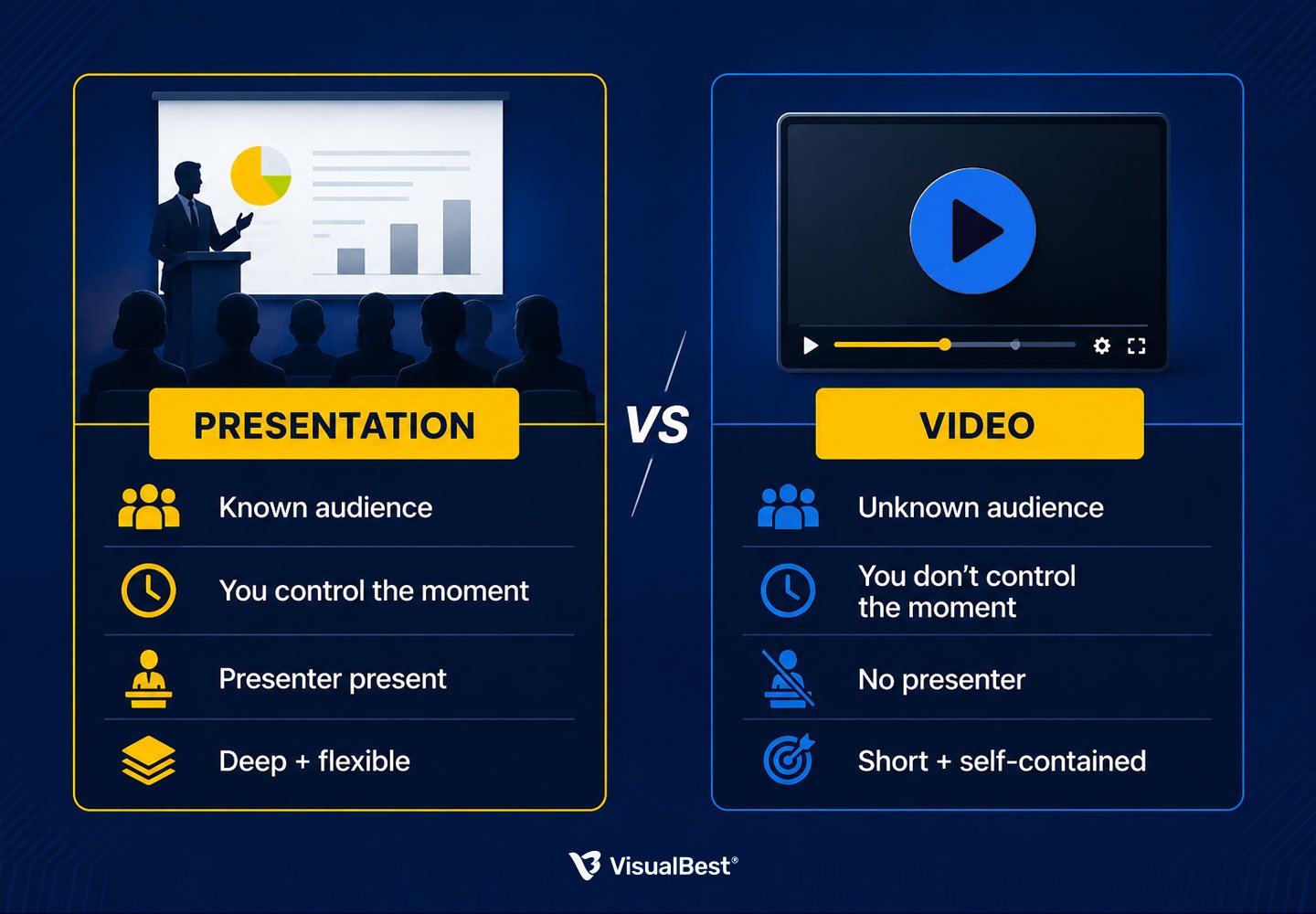
A presentation is built for a known audience in a moment you control. A video is built for an unknown audience at a moment you don’t.
Everything else follows from that. A deck assumes someone is there — a presenter, a room, a meeting, a context. A video assumes no one is there — it has to explain, persuade, and land entirely on its own, to a stranger who can leave at any second.
That single distinction answers most format questions before you even get to budget.
When An Explainer Video Wins
Reach for video when the conditions favour a self-contained, scalable, emotional format.
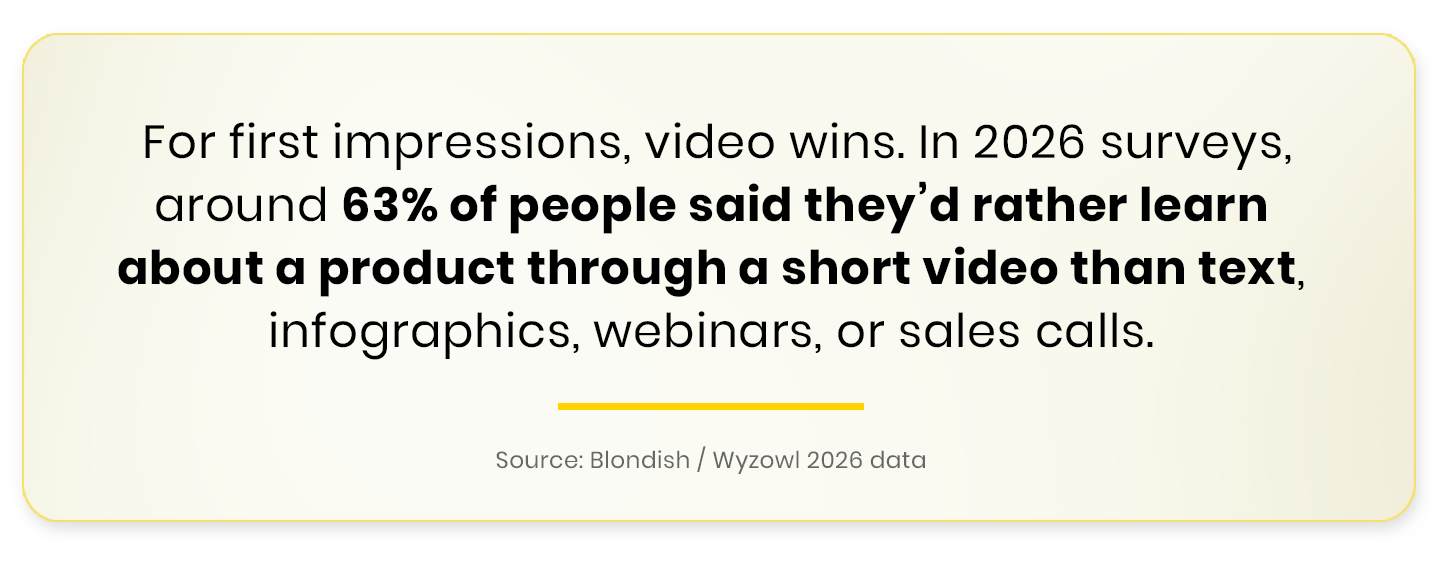
🔸 You’re explaining something to people who aren’t in the room. Website visitors, social audiences, inbound leads, app-store browsers. Video’s entire advantage is performing without you present — and audiences overwhelmingly prefer it for this.
🔸 The concept is hard to grasp in words. Abstract software, a novel process, a “you have to see it to get it” product. Motion, sequence, and visual metaphor explain things static slides struggle with — which is why explainer videos exist as a category at all.
🔸 You need scale and repeatability. One video explains your product identically to ten people or ten million, forever, without you in the loop. That’s leverage a deck can’t match.
🔸 The moment is short and the stakes are emotional, not detailed. A homepage hero, a launch teaser, a conference booth loop. You have seconds, and you need feeling and clarity, not depth.
🔸 It lives at the top of the funnel. Awareness, first impressions, “what does this company even do.” Video is built to hook a stranger; that’s its native habitat.
When a presentation wins
Reach for a deck when the conditions favour depth, flexibility, and a controlled room.
🔸 There’s a live audience and a presenter. A pitch meeting, a board review, a sales call, a keynote. When you’re in the room, a deck is the more powerful tool — it adapts in real time, responds to questions, and lets a skilled presenter read and steer the room. A video can’t do any of that.
🔸 The content is detailed, and the audience needs the detail. Financials, methodology, a multi-part strategy, a complex proposal. Decks hold depth that a 90-second video physically can’t — and high-stakes audiences (investors, boards, enterprise buyers) want to interrogate the detail, not be entertained past it.
🔸 The message will change. A sales deck that’s tailored per buyer, a strategy that evolves monthly, a pitch you refine after every meeting. Decks are cheap to edit; videos are expensive to re-cut. If the content has a short shelf life or needs constant tailoring, a deck is far more economical.
🔸 You need it tomorrow, on a real budget. A strong deck can be built in days. A quality custom explainer video takes weeks and a meaningfully larger budget. When speed or budget is tight, the deck is often the only realistic option.
🔸 It’s a document as much as a presentation. Something people will read, annotate, forward, and refer back to. A deck doubles as a leave-behind; a video is watched once and rarely revisited.

The Decision Framework
A stranger on LinkedIn will give you eight seconds.
A boardroom might give you forty minutes.
Trying to use the same communication format for both is like bringing a keynote presentation into a TikTok feed — or trying to close an enterprise deal with a launch trailer.
Different moments demand different tools.
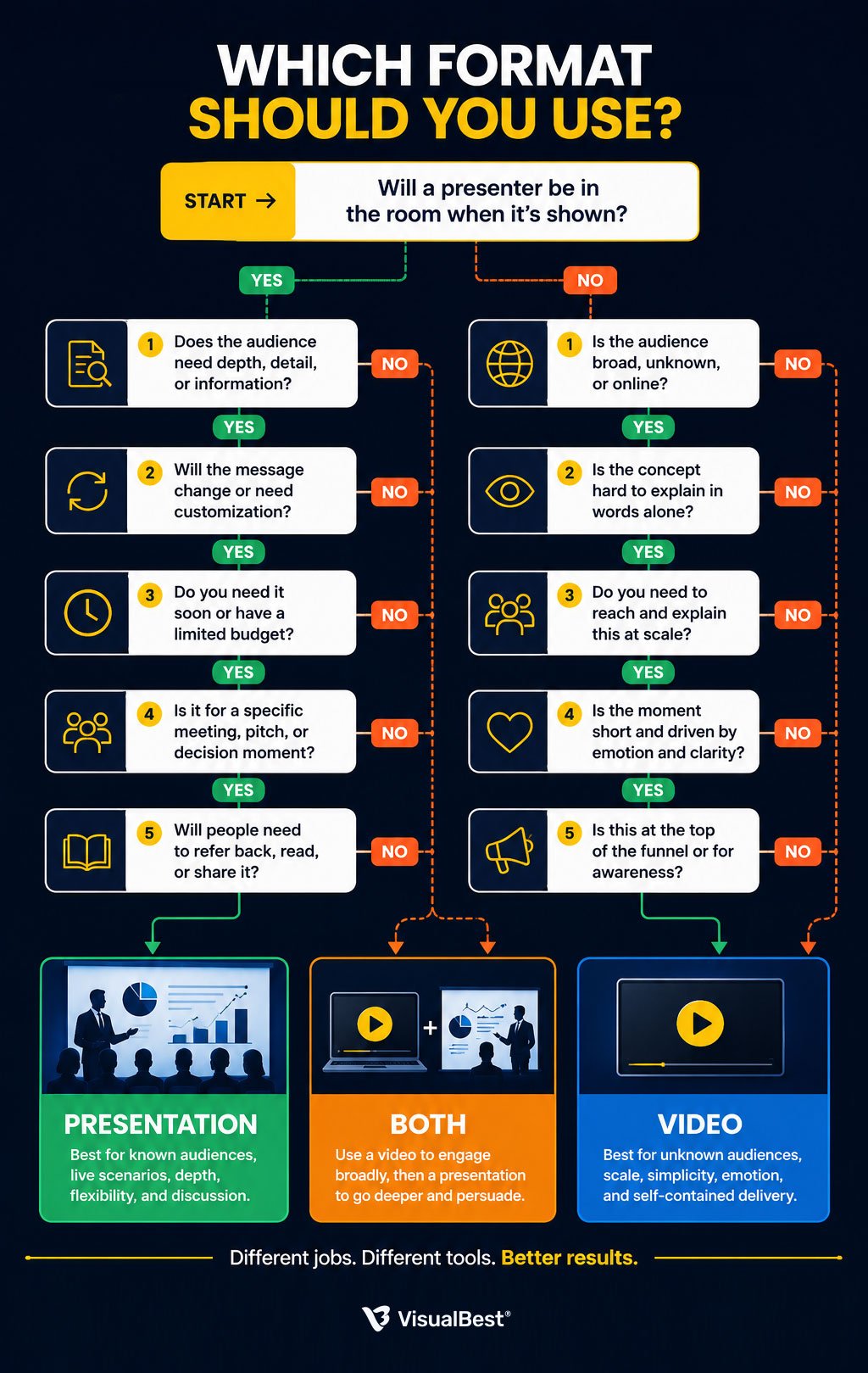
Five questions. Answer them honestly and the format usually picks itself.
- Will a presenter be there when it’s shown? Yes → lean presentation. No → lean video.
- Is the audience known and specific, or unknown and broad? Known/specific → presentation. Unknown/broad → video.
- Does the message need depth and detail, or feeling and clarity? Depth → presentation. Feeling → video.
- Will the content change often, or stay fixed for a year-plus? Changes often → presentation (cheap to edit). Fixed → video (worth the production).
- What’s the moment — a meeting, or a scroll? Meeting → presentation. Scroll, homepage, or feed → video.
If your answers cluster on one side, the choice is clear. If they’re split, read the next section — because split answers usually mean you need both.
The Trap: Treating It As Either/Or
The most common mistake isn’t picking the wrong format. It’s assuming you have to pick one.
The strongest 2026 content strategies use both, sequenced by funnel stage. A short explainer video hooks the stranger at the top — homepage, social, ad. Then a presentation does the deep work lower down — the sales call, the pitch, the board review — once that stranger has become a real prospect in a real conversation. Video earns attention; the deck closes the deal. They’re not competitors. They’re a relay.
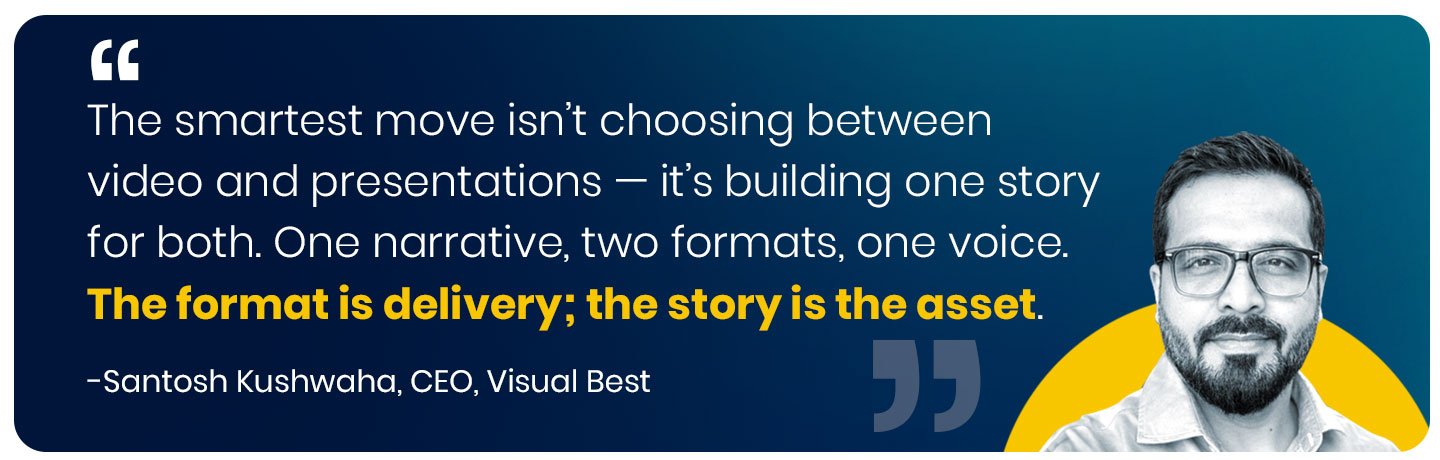
And the assets feed each other. The narrative you build for a pitch deck is the script for your explainer video. The data story in your video becomes a slide. Companies that build both from one core narrative get a coherent message across every touchpoint — and spend less than building each from scratch.
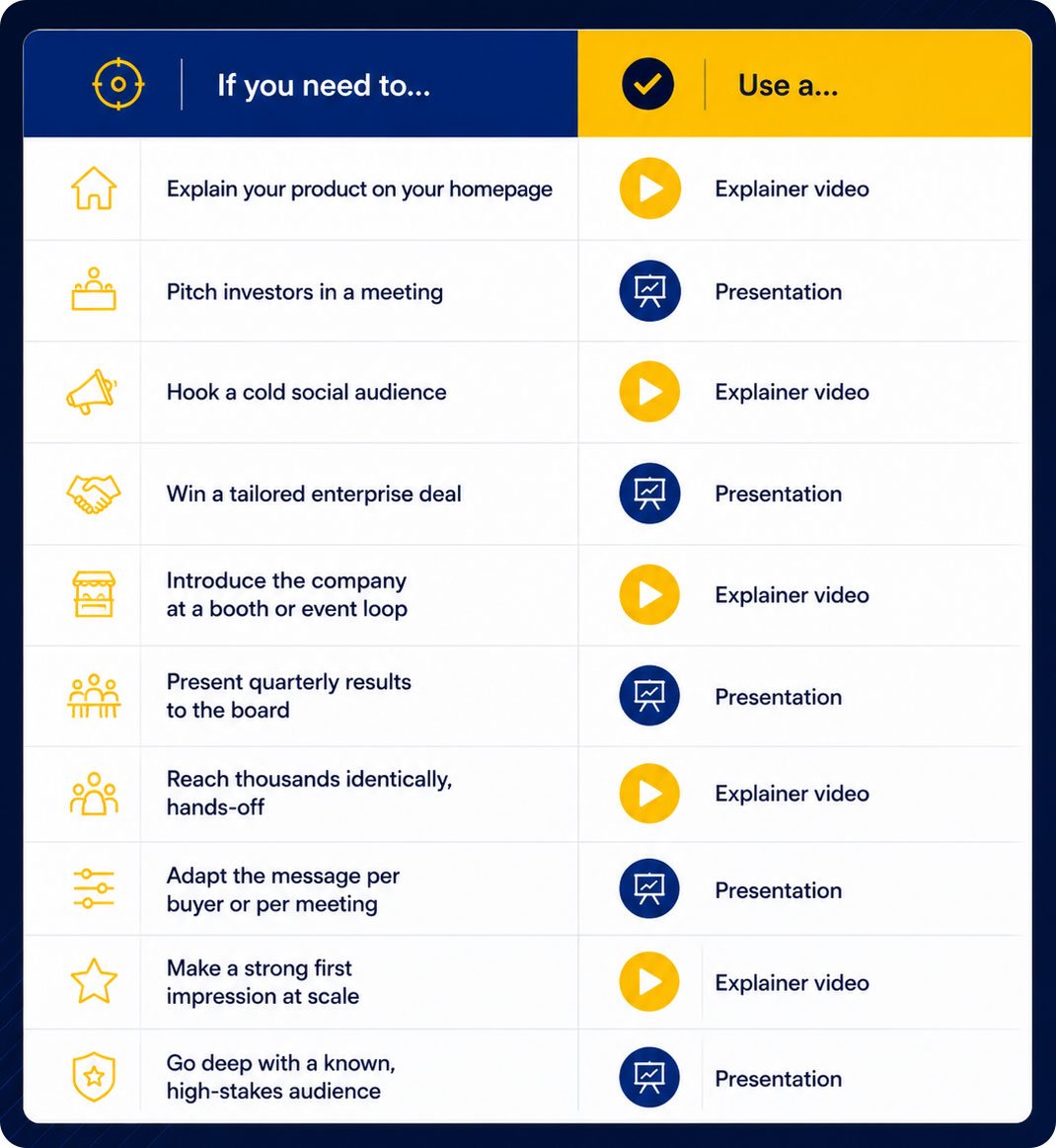
A Quick Reference Table

Frequently Asked Questions
1. Is an explainer video better than a presentation?
Neither is universally better — they solve different problems. Video works best for broad audiences without a presenter; presentations work best for live, high-stakes conversations where depth and flexibility matter.
2. When should a company use an explainer video instead of a presentation?
Use video when no presenter will be there, the audience is broad, and the goal is fast, scalable communication — like homepage, social, or product-introduction content.
3. Can a presentation and an explainer video be used together?
Yes — and often they should be. Video grabs attention early; presentations do the deeper persuasive work later in the sales or decision-making process.
4. How long should an explainer video be?
Most effective explainer videos are around 60–90 seconds. The goal is to create clarity and interest, not explain everything.
5. Is a video or a presentation more expensive?
Custom explainer videos usually cost more and take longer because of scripting, animation, and production. Presentations are faster, easier to update, and more economical for changing content.
6. Which format is better for B2B?
Usually both. Videos work well early in the funnel to explain complex products quickly, while presentations are more effective for tailored sales conversations, demos, and stakeholder meetings.
Related reading
- Best Corporate Presentation Design Examples in 2026 — what a great deck looks like, when the presentation is the right call.
- 10 Presentation Design Mistakes That Make Companies Look Unprofessional —
if you’re going the presentation route, avoid these first. - Presentation Design Cost in India (2026 Guide) — what a professional deck costs, for budget comparison.